
Business credit belongs to the company and lives under its EIN, which generally keeps its ups and downs off your personal report. Personal credit is tied to your Social Security number and follows you no matter which company you run. The line blurs the moment you sign a personal guarantee, which most lenders require from young or thinly capitalized businesses. The action item is simple: pull both your personal report and your business file, then start building trade lines in the company’s name.
TL;DR:
- Business credit scoring relies on the company’s EIN and reporting, which can lead to higher credit limits and separate liability from personal debt.
- Most small businesses start building credit with vendors that report trade lines, but many suppliers do not report activity, risking missed credit opportunities.
- Personal guarantees are common for young or undercapitalized businesses and can expose personal assets unless negotiations limit their scope and duration.
- Business credit typically remains separate from personal credit unless a debt is personally guaranteed or a credit card reports activity to personal files.
- Engaging an advisor can help negotiate better guarantee terms and access funding sources quickly, preventing personal exposure from unfavorable loan conditions.
Table of Contents
- Business Credit vs Personal Credit at a Glance
- How Credit Reporting and Scoring Differ
- When Personal Credit Affects Business Financing
- Does Business Credit Affect Personal Credit, and Vice Versa?
- How to Build Business Credit Step by Step
- When Using Personal Credit Makes Sense, and When It Doesn’t
- How an Advisor Can Reduce Your Personal Exposure
- The Negotiation Posture Founders Skip
- When to Contact Surge Financial
- Sources
Business Credit vs Personal Credit at a Glance
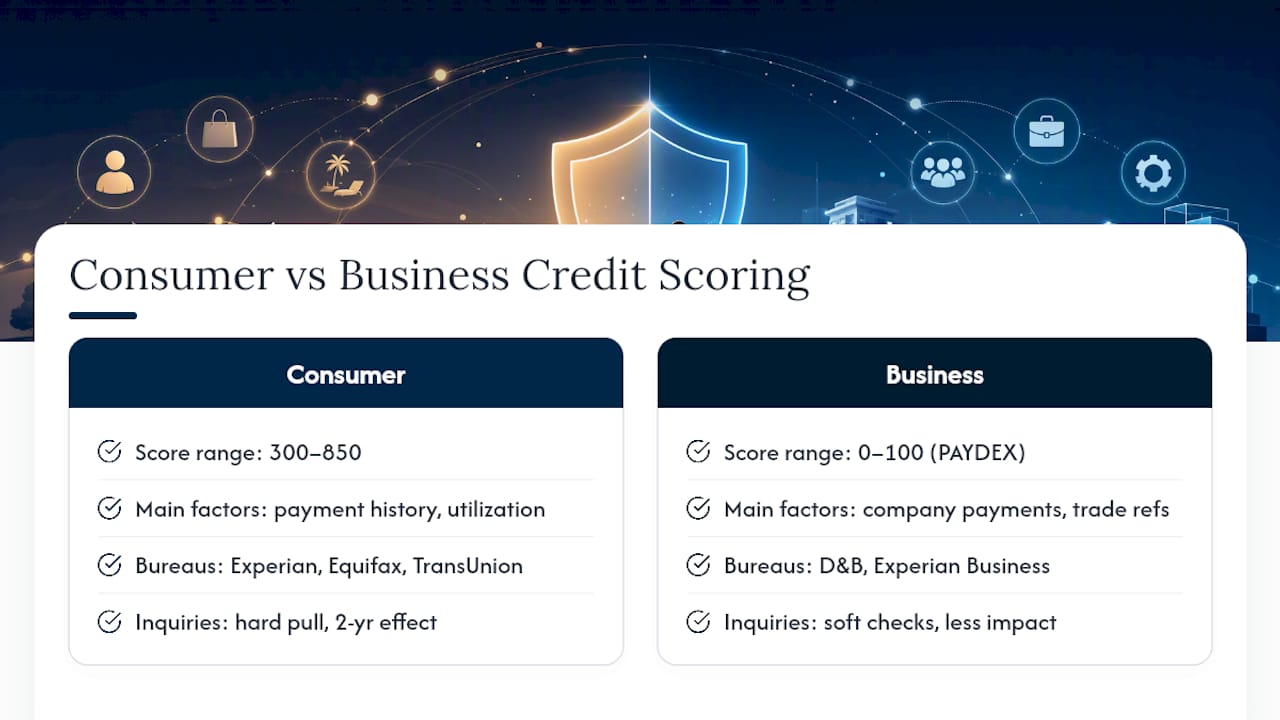
The two systems track different identities, use different scoring math, and carry different consequences when something goes wrong. Personal credit runs on your Social Security number through Experian, Equifax, and TransUnion, with FICO scores ranging from 300 to 850. Business credit runs on your EIN through commercial bureaus like Dun & Bradstreet, Experian Business, and Equifax Commercial, often scored on different scales entirely, such as Dun & Bradstreet’s PAYDEX system.
Here’s how the practical differences shake out:
- Liability: Personal credit debt is your legal obligation; business credit debt belongs to the entity unless you’ve personally guaranteed it.
- Reporting: Personal accounts report to consumer bureaus monthly; business accounts often report only if the vendor or lender chooses to.
- Credit limits: Business trade lines can scale with revenue, sometimes reaching far higher limits than a personal card would ever offer.
- Example: A supplier extending net-30 terms builds your Dun & Bradstreet file, while a personal credit card used for the same purchase builds only your FICO score.
How Credit Reporting and Scoring Differ
Consumer credit scoring is familiar territory. Experian, Equifax, and TransUnion each generate a FICO score between 300 and 850, weighted heavily by payment history and credit utilization. Business credit works on a parallel but distinct track. Experian explains that commercial bureaus evaluate a company’s own payment history, trade references, and public filings, tied to its EIN rather than an owner’s SSN. Dun & Bradstreet’s PAYDEX score runs 0 to 100 and rewards paying invoices early, not just on time, a subtle but important departure from consumer scoring logic.
Vendor accounts are the entry point for most small businesses. Suppliers that extend net-30 or net-60 terms and report that activity to Dun & Bradstreet or Experian Business give you trade lines that build a commercial file from scratch. Prioritize vendors that actually report; Experian notes that many suppliers extend terms without ever reporting them, which means the payment history you’re building disappears into thin air.
Inquiries matter differently, too. A hard pull on your personal credit, the kind triggered by a new credit card or auto loan, can shave a few points off your FICO score and stays on your report for two years. Business credit checks are typically softer and rarely dent a commercial score the same way, though lenders reviewing a loan application will often still pull your personal file alongside the business one.
When Personal Credit Affects Business Financing
Lenders lean on personal guarantees because a young business often has no track record and no substantial collateral to fall back on. The SBA notes that this is standard practice across most small-business loan programs, not a red flag specific to your application. A personal guarantee is a legally binding promise, and depending on how it’s drafted, it can expose your house, savings, and other personal assets if the business defaults. Some guarantees are written as “unlimited” or “all monies,” meaning they cover every debt the business ever owes the lender, not just the loan in front of you.
Before signing anything, work through this checklist:
- Ask whether the guarantee can be capped at a specific dollar amount rather than left open-ended.
- Request a sunset clause that releases you from the guarantee after a set period of on-time payments.
- Push to remove any waiver-of-exhaustion clause, which lets the lender come after you personally before pursuing the business’s own assets.
- Confirm whether the guarantee transfers automatically if you sell the business, and negotiate a replacement-guarantor provision.
These aren’t fringe requests. Legal guidance on personal guarantees treats capped, time-limited guarantees as standard negotiation territory, not a favor the lender is doing you.
Pro Tip: Raise guarantee terms before you accept a term sheet, not after. Once you’ve signed, your leverage to negotiate caps or sunset clauses disappears almost entirely.
Does Business Credit Affect Personal Credit, and Vice Versa?
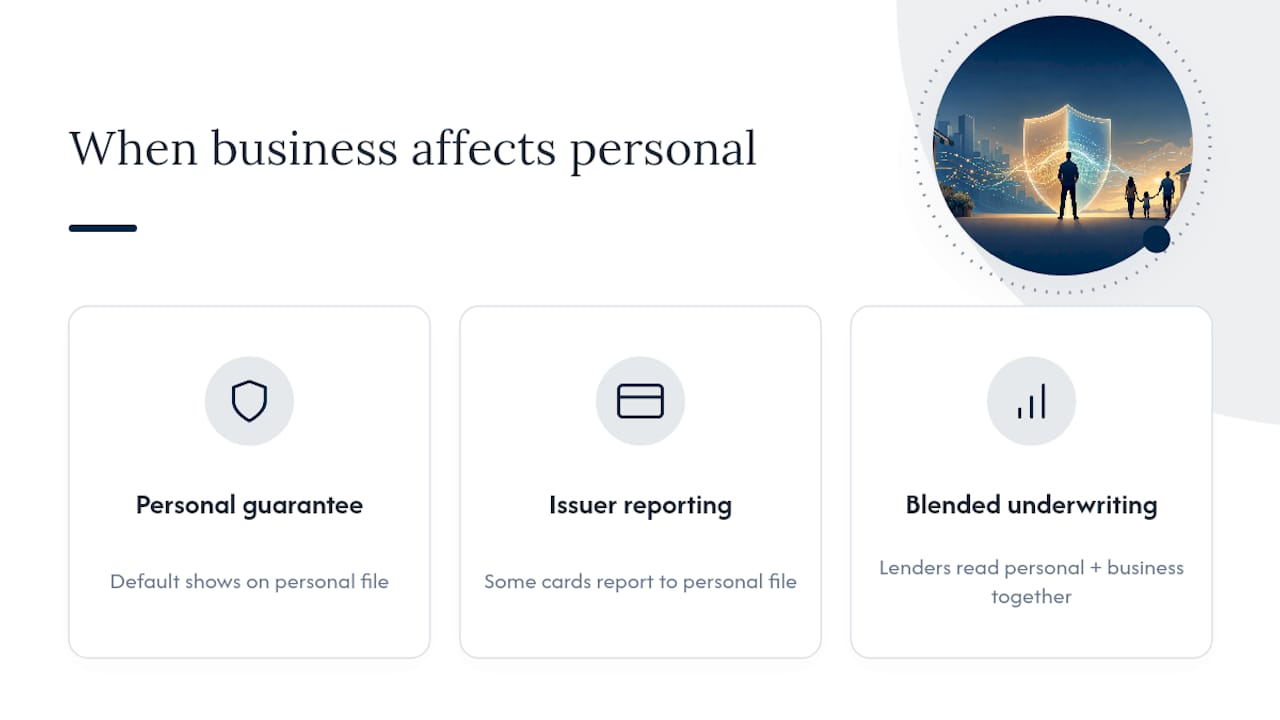
The two files stay separate under normal circumstances. Your business paying a supplier late doesn’t touch your personal FICO score unless you’ve personally guaranteed that debt. Chase’s guidance on the topic confirms that business credit doesn’t automatically appear on personal credit reports unless specific triggers, like a default on a guaranteed loan, come into play.
Card issuer behavior complicates this picture. Some business credit cards report account activity to your personal credit file even when there’s no default, particularly with small-business cards from major issuers that treat the owner’s SSN as the primary underwriting factor. That means a maxed-out business card can quietly raise your personal utilization ratio.
Lenders have also gotten more sophisticated. Experian’s research points to a shift toward blended commercial scoring, where underwriters weigh personal credit history alongside business financials rather than treating them as fully independent signals. If you’re applying for financing, assume both files are being read together, not one instead of the other.
How to Build Business Credit Step by Step
Separating your credit starts with structure, not just paperwork. Follow this sequence:
- Form a distinct legal entity (LLC or corporation) and obtain an EIN from the IRS, since business credit can’t exist without one.
- Open a dedicated business bank account to keep company cash flow separate from personal spending.
- Set up vendor accounts that report, prioritizing suppliers known to report payment history to Dun & Bradstreet or Experian Business.
- Apply for a business credit card or line of credit that reports specifically to commercial bureaus, not just your personal file.
- Pay early, not just on time, since PAYDEX and similar scores reward early payment more than standard FICO models do.
- Monitor your Dun & Bradstreet and Experian Business reports regularly to catch errors before they affect a loan application.
Once you have two or three reporting trade lines and six months of clean payment history, start shifting larger purchases, equipment, inventory, and even equipment financing, off your personal cards and onto business credit. That timing matters: moving too early, before you have any commercial trade lines, just means the purchase goes unreported and does nothing for your business file. Shopify’s guidance on this transition recommends waiting until at least one vendor account is actively reporting before making the switch a habit.
When Using Personal Credit Makes Sense, and When It Doesn’t
Plenty of owners put a first purchase order or a laptop on a personal card simply because the business has no credit history yet. That’s a reasonable short-term bridge. The trouble starts when it becomes the default financing method for the business’s ongoing life. A personal card ties your growth to a limit, often just a few thousand to $25,000, that isn’t built for scaling inventory or payroll.
Weigh these before reaching for a personal card again:
- Short-term use case: A one-time equipment purchase before vendor accounts are established is low-risk.
- Recurring use case: Financing monthly inventory or payroll on a personal card signals it’s time to apply for a business line of credit instead.
- Exposure check: Every dollar on a personal card is fully your liability, with no separation if the business struggles.
- Alternatives worth comparing: SBA microloans, revenue-based financing, and business lines of credit all avoid stacking business risk onto your personal file.
The SBA’s microloan program exists specifically for owners in this early gap, offering smaller loan amounts with underwriting built for businesses that haven’t yet built a commercial credit file.
How an Advisor Can Reduce Your Personal Exposure
Negotiating guarantee terms and comparing lender options on your own takes time most owners don’t have. An advisor or broker packages your application, presents it to multiple lenders simultaneously, and negotiates caps, sunset clauses, or exhaustion provisions on your behalf, the same terms outlined earlier in this guide. That negotiation leverage often produces materially better terms than an owner gets going in alone.
Surge Financial has facilitated more than $2 billion across 500-plus closed deals, working across small business loans, SBA programs, equipment financing, and real estate transactions.
- No upfront fees and no hard credit pulls during the initial assessment.
- Funding decisions typically land within one to three business days.
- A dedicated capital advisor reviews your specific guarantee terms before you sign.
Call an advisor when a lender hands you an unlimited guarantee, or when you need financing fast enough that self-serve applications aren’t realistic.
The Negotiation Posture Founders Skip
Founders tend to treat the personal guarantee section of a term sheet as a formality, something to sign quickly so the money shows up sooner. That’s backward. The guarantee is often the single riskiest clause in the entire agreement, and it’s also the most negotiable one, precisely because lenders expect pushback and rarely walk away over a capped guarantee request.
The mistake I see most often isn’t taking on a guarantee. It’s accepting an unlimited one when a capped, time-limited version was available for the asking. Leverage peaks before you sign, not after. Once funds are disbursed, your ability to renegotiate the guarantee all but vanishes.
Pro Tip: Bring up guarantee caps and sunset clauses during the term-sheet stage, when the lender is still competing for your business, not during final signing when they’ve already assumed you’re committed.
— Brandon
When to Contact Surge Financial
If you’ve read this far, you already know that separating your business and personal credit isn’t a one-time task; it’s an ongoing negotiation every time you borrow. Surge Financial works as a capital advisory partner across SBA loans, equipment financing, revenue-based funding, and real estate financing, with no upfront fees and no hard credit pull required to start the conversation.
Surge is built for owners who need funding fast, real estate investors managing multiple deals, and any business owner who wants a negotiated guarantee rather than the first term sheet a lender offers. A dedicated capital advisor reviews your file, presents options across multiple funding sources, and typically returns a decision within one to three business days. Before reaching out, gather your recent bank statements and a summary of what you’re financing; check the funding requirements page to see exactly what’s needed. When you’re ready, start your inquiry through Surge Financial’s business funding page.
Sources
Get Started with Surge Financial
Talk to a dedicated Surge Financial advisor. No hard credit pull, no upfront fees, and you see every option before deciding.
Get Started →