
You can get a business loan without collateral. Many small business owners do it every year through unsecured term loans, SBA programs, revenue-based financing, and invoice products. The trade-offs are real: expect higher interest rates, shorter repayment terms, lower loan caps, and almost certainly a personal guarantee. But for asset-light businesses, service companies, and owners who simply don’t want to pledge property, unsecured business financing is a legitimate and widely used path.
Your best first options, in order of cost and accessibility: SBA Microloans and small 7(a) loans, unsecured lines of credit from banks or online lenders, invoice financing, and revenue-based financing. Before you approach any lender, pull your personal credit report, gather three to six months of business bank statements, and either run a prequalification check or consult a capital advisor who can match you to the right product.
Key Takeaways
Unsecured business loans are accessible to most small businesses with solid credit and steady revenue, but the right product depends on your specific financial profile and funding need.
| Point | Details |
|---|---|
| Unsecured loans are available | Most small businesses can qualify without pledging collateral if personal credit and revenue meet lender minimums. |
| Personal guarantees are standard | Even without collateral, expect to sign a personal guarantee making you personally liable for the debt. |
| Costs vary widely by product | APRs range from roughly 8% on SBA Microloans to 150%+ on merchant cash advances; always ask for the full APR equivalent. |
| Preparation improves approval odds | Gather bank statements, tax returns, and a use-of-funds memo before approaching any lender. |
| Surge-financial matches you to the right lender | With $2B+ facilitated and no upfront fees, Surge-financial’s advisors identify the best-fit product and lender for your profile. |
Table of Contents
- What a business loan without collateral actually means
- Loan types that commonly require little or no collateral
- What you gain and what you trade away
- What lenders look for when you apply without collateral
- Typical costs and timelines for no-collateral loans
- How to prepare and apply: a step-by-step approach
- Alternatives if you can’t get unsecured financing
- Risks and red flags to watch for with no-collateral offers
- How Surge-financial helps you secure funding without collateral
- Surge-financial: get matched to the right funding, fast
- Sources
What a business loan without collateral actually means
In standard lending, a secured loan requires you to pledge a specific asset, such as real estate, equipment, or inventory, that the lender can seize if you default. An unsecured business loan skips that pledge. The lender evaluates your creditworthiness and cash flow instead of your asset base, per SBA guidance on unsecured funding.
That does not mean lenders take on unlimited risk. Most will still require a personal guarantee, which makes you personally liable for the debt if the business can’t pay. Many also file a UCC-1 lien, a blanket claim against your business assets that doesn’t require you to name a specific piece of collateral upfront but does give the lender a legal claim if things go wrong. These protections replace the traditional collateral requirement rather than eliminate lender protection entirely.
Pro Tip: The three factors lenders weight most heavily on unsecured applications are personal credit score, average monthly bank deposits, and revenue consistency. Pull your credit report at AnnualCreditReport.com today and dispute any errors before you apply. A 30-point score improvement can shift you from a decline to an approval on many online lender platforms.
Loan types that commonly require little or no collateral
Several distinct products fall under the no-collateral umbrella. Each has a different use case, cost structure, and repayment shape.
Short-term unsecured term loans and lines of credit
Unsecured term loans typically range from $10,000 to $250,000 and carry repayment periods of 6–24 months. An unsecured business credit line works similarly but lets you draw, repay, and redraw up to a set limit, making it better for recurring working capital needs than a lump-sum purchase. Banks offer these to established businesses with strong credit; online lenders extend them to younger businesses at higher rates.
SBA Microloans and small 7(a) loans
The SBA’s loan programs include two products that can work without traditional collateral at smaller amounts. SBA Microloans go up to $50,000 and are administered through nonprofit intermediaries; they’re designed for startups and underserved businesses and often waive the collateral requirement at lower loan sizes. Certain small 7(a) loans, generally under $25,000, may also be approved without collateral, though SBA rules require a personal guarantee from any owner holding 20% or more regardless of collateral status.
Invoice financing and accounts receivable financing
If your business invoices other companies, your outstanding receivables can serve as the basis for funding. A lender advances you 70%–90% of the invoice value and collects repayment when your customer pays. The invoice itself acts as the collateral, so you’re not pledging business or personal property. This works well for B2B service firms, staffing companies, and contractors with reliable clients but slow payment cycles.
Merchant cash advances
A merchant cash advance (MCA) provides a lump sum in exchange for a percentage of your future credit card or debit sales. Repayment is automatic and daily, drawn directly from your merchant account. MCAs fund fast, sometimes same-day, but carry factor rates that translate to very high effective APRs. They suit businesses with strong card-based revenue and a short-term cash gap, not long-term capital needs.
Revenue-based financing
Revenue-based financing ties repayment to a fixed percentage of monthly revenue rather than a set payment schedule. When revenue dips, your payment dips with it. Lenders typically require at least $10,000–$15,000 in monthly revenue and six or more months in business. This product is common among SaaS companies, subscription businesses, and e-commerce sellers with predictable but variable income.
Equipment and inventory financing as near-unsecured alternatives
Equipment loans and inventory lines are technically secured, but the purchased asset itself serves as the collateral. You don’t pledge outside property. For a business buying machinery, vehicles, or large inventory, this is often the most cost-effective path because the collateral is built into the transaction.
Market context: The unsecured business loans market was valued at $261.6 billion in 2024, reflecting how broadly small businesses rely on credit-based rather than asset-based financing.
What you gain and what you trade away
Unsecured financing has a clear value proposition for the right business. It also has real costs that owners sometimes underestimate.
The advantages:
- No specific asset at risk of seizure if you default on the loan itself
- Faster approval and funding, often days rather than weeks
- Preserves your ability to sell, refinance, or reinvest assets freely
- Accessible to service businesses and startups with limited physical assets
The trade-offs:
- Higher interest rates than secured products, reflecting the lender’s added risk
- Shorter repayment terms, which raise monthly payment obligations
- Lower maximum loan amounts compared to secured financing
- Personal guarantees remain standard, so your personal credit and assets are still on the line
When unsecured makes sense: A retail shop needing $40,000 for seasonal inventory, a marketing agency covering payroll during a slow quarter, or a healthcare clinic expanding services without tying up its building in a lien. In each case, the funding need is short-term, the business has recurring revenue, and the cost of a higher rate is manageable against the return.
When secured is smarter: Large capital expenditures, equipment purchases over $100,000, or businesses with thin cash flow where a higher monthly payment would strain operations. In those cases, pledging an asset to get a lower rate and longer term often produces a better financial outcome.
Pro Tip: Before accepting a personal guarantee, ask the lender whether a limited guarantee (capped at a specific dollar amount or time period) is available. Some lenders will negotiate this on smaller loans, particularly if your credit profile is strong.
What lenders look for when you apply without collateral
Lenders compensate for the absence of collateral by scrutinizing your financial profile more closely. Here’s what they typically require:
Credit thresholds:
- Personal credit score of 600+ for most online lenders; 680+ for bank products and SBA loans
- Business credit profile (Dun & Bradstreet, Experian Business) reviewed where available
- No recent bankruptcies, foreclosures, or unresolved tax liens
Business operating history:
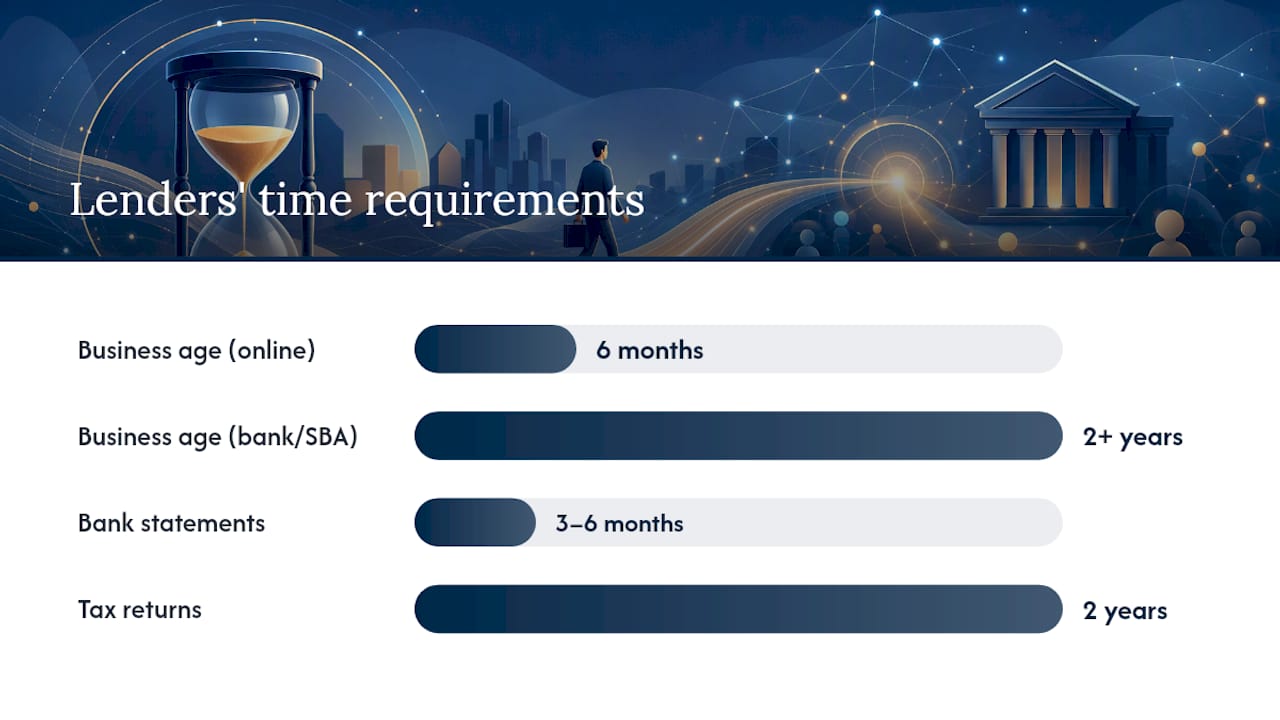
- Minimum 6 months in business for online lenders
- 2+ years for traditional bank loans and most SBA products
- Consistent revenue over the qualifying period, not just recent spikes
Revenue and cash flow:
- Minimum monthly revenue of $10,000–$15,000 for most online unsecured products
- Debt Service Coverage Ratio (DSCR) above 1.25 preferred, meaning your net operating income covers debt payments by at least 25%
- Clean bank statements with regular deposits and no chronic overdrafts
Documentation lenders commonly request:
- 3–6 months of business bank statements
- 2 years of business and personal tax returns
- Profit and loss statement (current year)
- Accounts receivable aging report (for invoice-based products)
- Government-issued ID and business formation documents
How lenders weigh personal versus business credit depends on the product. Online lenders lean heavily on personal credit and bank statement cash flow. Banks and SBA lenders give more weight to business financials and tax returns. A personal guarantee shifts some underwriting risk back to you personally, which is why your personal credit score matters even on a business application. Check Surge-financial’s funding requirements for a detailed breakdown of what advisors typically see across lender types.
Typical costs and timelines for no-collateral loans
Rates and fees vary significantly by product type and borrower profile. The table below shows typical ranges across common unsecured products.
| Product | Typical APR Range | Common Fees | Time to Fund |
|---|---|---|---|
| Bank unsecured term loan | 7%–25% | Origination 1%–3% | 1–4 weeks |
| Online unsecured term loan | 20%–40% | Origination 1%–5% | 1–5 business days |
| SBA Microloan | 8%–13% | Varies by intermediary | 2–4 weeks |
| Invoice financing | 15%–35% effective | Factoring fee 1%–5% per invoice | 1–3 business days |
| Merchant cash advance | 40%–100%+ effective | Factor rate 1.3 | Same day to 2 days |
| Revenue-based financing | 20%–40% effective | Origination or draw fee | 2–5 business days |
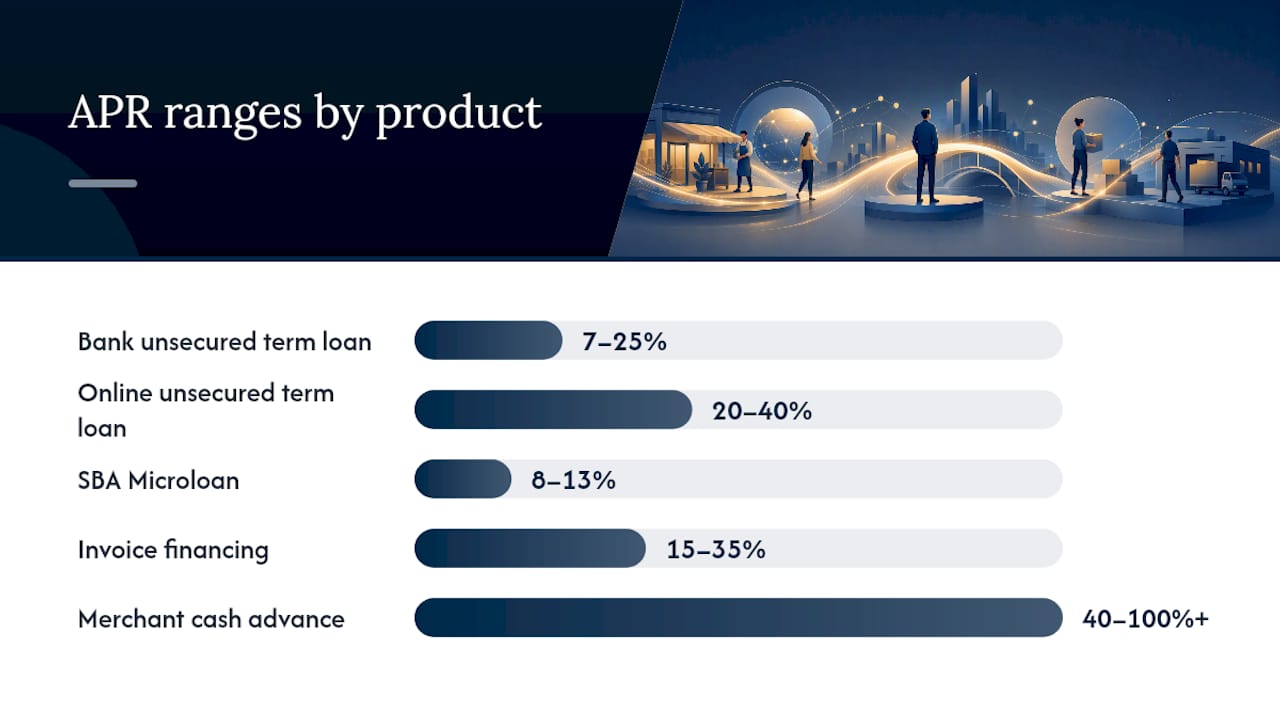
A few things to note about this table. MCA and revenue-based products often quote a factor rate rather than an APR. A factor rate of 1.3 on a $50,000 advance means you repay $65,000 total, but the effective APR depends entirely on how quickly you repay. Short repayment periods drive the effective rate up sharply.
Stripe’s market analysis confirms that APRs on unsecured products vary widely depending on both the lender type and the borrower’s credit profile. A borrower with a 720 personal credit score and 24 months of clean bank statements will see materially lower rates than one with a 610 score and six months of history, even from the same lender.
Watch for origination fees deducted from your loan proceeds (you receive less than the stated loan amount), prepayment penalties that eliminate any savings from paying early, and daily or weekly debit repayment structures that can strain cash flow.
How to prepare and apply: a step-by-step approach
A well-prepared application package meaningfully improves your approval odds and can shorten the time to funding.
- Pull your credit reports. Check personal credit through AnnualCreditReport.com and business credit through Dun & Bradstreet or Experian Business. Dispute errors before you apply.
- Gather your documents. Collect 3–6 months of bank statements, two years of tax returns (business and personal), a current P&L, and your business formation documents. Have them in a single folder, ready to upload.
- Run a prequalification. Most online lenders offer a soft-pull prequalification that won’t affect your credit score. Use it to gauge likely approval and rate ranges before submitting a full application.
- Write a short use-of-funds memo. One paragraph explaining what you’ll do with the capital and how it generates or protects revenue. Lenders appreciate clarity; it also helps you avoid borrowing more than you need.
- Choose 2–3 lender types to approach. Don’t apply to ten lenders simultaneously. Multiple hard pulls in a short window can lower your score. Target one bank or credit union, one online lender, and one SBA intermediary if you qualify.
- Review bank statement presentation. Lenders flag chronic overdrafts, large unexplained deposits, and irregular patterns. If your statements have any of these, be ready to explain them in writing.
- Submit and respond quickly. Lenders often need follow-up documents within 24–48 hours. Slow responses extend timelines and can result in a declined file if underwriting windows expire.
If a lender asks you to sign a personal guarantee, read the scope carefully. An unlimited personal guarantee covers the full loan balance plus fees and legal costs. A limited guarantee caps your exposure. Ask whether a limited guarantee is available, and if the lender won’t negotiate, factor that into your decision about whether to proceed.
Alternatives if you can’t get unsecured financing
Not every business qualifies for unsecured products. If your credit score is below 600, your revenue is below lender minimums, or you’re under six months in business, these alternatives are worth considering.
- SBA-guaranteed secured loans: The SBA 7(a) program allows lenders to extend credit with government backing, often at lower rates than unsecured products. Collateral is required for larger amounts, but the guarantee reduces lender risk and can make approval more accessible. Use the SBA’s Lender Match tool to find approved lenders in your area.
- Equipment financing: If your capital need involves purchasing equipment, the equipment itself secures the loan. Rates are typically lower than unsecured products, and approval can be faster because the collateral is clear. Surge-financial’s equipment financing options cover a range of industries and asset types.
- Business credit cards: For smaller, recurring expenses, a business credit card with a 0% introductory APR can bridge short gaps without a formal loan application. Credit limits are lower, but there’s no collateral and no origination fee.
- Grants: Federal, state, and nonprofit grant programs exist for specific industries, demographics, and business types. They take longer to secure but carry no repayment obligation. The SBA’s website lists several starting points.
- Investor funding: Angel investors or revenue-share investors may provide capital in exchange for equity or a revenue percentage. This avoids debt entirely but dilutes ownership or future revenue.
For real estate investors who need capital tied to a property’s income rather than personal credit, DSCR lending is a separate category worth exploring.
Pro Tip: If you’re turned down for an unsecured loan, ask the lender specifically what criteria you missed. Most will tell you. That feedback is a direct roadmap for what to fix before your next application.
Risks and red flags to watch for with no-collateral offers
The unsecured lending space includes legitimate lenders and predatory ones. Knowing the difference before you sign protects your business.
Red flags to watch for:
- Daily-debit MCA structures that pull repayment every business day, regardless of your cash position. These can drain accounts faster than revenue comes in.
- Factor rates presented without APR equivalents. A factor rate of 1.4 sounds neutral until you calculate the effective APR on a 90-day repayment schedule.
- Mandatory prepayment penalties that eliminate any benefit from paying early.
- Lenders who pressure you to sign same-day without allowing time to review the agreement.
- Upfront fees before funding. Legitimate lenders deduct fees from proceeds or charge at closing, not before.
Verification steps:
- Check the lender’s registration with your state’s financial regulator.
- Verify FDIC membership for bank lenders at Fdic.
- Search the lender’s name on the Better Business Bureau website for complaint history.
- Ask for references from other business owners in your industry who have used the lender.
Opaque fee structures are the most common problem. Ask directly: “What is the total repayment amount?” and “What is the effective APR?” Any lender unwilling to answer those two questions clearly is not a lender you should work with.
How Surge-financial helps you secure funding without collateral
Working with a capital advisor changes the application experience in practical ways. Surge-financial has facilitated over $2 billion in funding across 500+ deals, covering unsecured business loans, SBA programs, revenue-based financing, lines of credit, and equipment financing.
The advisor process at Surge-financial starts with a no-upfront-fee, no-hard-credit-pull assessment. An advisor reviews your financials, identifies the products you’re most likely to qualify for, and matches you with lenders from a broad network. They handle documentation preparation, follow up with underwriters, and typically move qualified clients from application to funding within 1–3 business days.
This matters most in three situations: when you’ve been declined before and don’t know why, when you need funding quickly and can’t afford to waste time on lenders that won’t approve your profile, and when your business has nontraditional strengths (strong recurring revenue, high gross margins, a niche industry) that a generic online application doesn’t capture well.
Pro Tip: If you’re considering multiple lender types simultaneously, an advisor can run a coordinated approach that avoids duplicate hard pulls and positions your application consistently across lenders. Self-applying to multiple lenders without coordination often results in conflicting information and declined files.
Surge-financial works with retail businesses, healthcare clinics, contractors, restaurants, and many other industries. Review the full range of business funding services to see which products fit your situation.
A note from Brandon
The most common mistake I see is owners applying for the wrong product at the wrong time. A business with six months of history and $12,000 in monthly revenue is not a bank loan candidate today, but it may be a strong fit for revenue-based financing or an SBA Microloan. The goal isn’t to get any loan; it’s to get the right one at a cost your cash flow can actually support. Unsecured financing is genuinely useful when it fits the business model and the repayment timeline. When it doesn’t, a secured or hybrid option often produces a better outcome at lower cost. The key is knowing which category you’re in before you apply, not after.
Surge-financial: get matched to the right funding, fast
Finding a no-collateral loan on your own means sorting through dozens of lenders, each with different credit thresholds, rate structures, and product types. The wrong match costs you time, hard credit pulls, and sometimes a decline that affects your next application.
Surge-financial cuts that process down to a single conversation. Advisors assess your financials, identify which unsecured products you’re most likely to qualify for, and connect you with lenders from a broad network, all with no upfront fees and no hard credit pull at the assessment stage. Clients across retail, healthcare, construction, and services have moved from first contact to funded in as little as one business day. If you’re ready to find out what you qualify for, speak with a capital advisor today.
Sources
- Loans - Small Business Administration
- Unsecured Business Funding for Small Business Owners Explained | U.S. Small Business Administration
- What are unsecured business loans? | Stripe
- Fdic
This article provides general information about business financing options and is not a substitute for professional financial or legal advice. Loan terms, eligibility requirements, and program rules change frequently. Confirm current details with lenders, the SBA, or a qualified financial advisor before making funding decisions.
Recommended
Get Started with Surge Financial
Talk to a dedicated Surge Financial advisor. No hard credit pull, no upfront fees, and you see every option before deciding.
Get Started →