
Qualified real estate investors can secure a construction loan for investment properties, but approval hinges on three things: sponsor equity in the deal, a complete project package, and a credible permanent takeout plan. Before you approach a lender, assemble your sources and uses breakdown, a schedule of values, your general contractor’s agreement, and a preliminary refinance strategy. Lenders underwrite the plan as much as the property.
TL;DR:
- A construction loan’s approval depends on sponsor equity, a complete project package, and a credible permanent takeout plan, with thorough documentation needed upfront.
- Loan-to-cost ratios for ground-up projects typically range from 65 to 80 percent, requiring 20 to 35 percent sponsor equity, and rate spreads can reach 400 basis points over SOFR.
- Accurate sizing of the interest reserve depends on a draw schedule modeling the typical S-curve, not a flat 50 percent average, to avoid underfunding during peak construction.
- Supporting documentation for draw requests must include detailed invoices, lien waivers, progress photos, and an updated schedule, coordinated closely with contractors’ payment cycles.
- Locking a confirmed takeout before finalizing a general contractor contract minimizes risk and ensures smoother refinancing or exit, especially in a tightening credit environment.
Table of Contents
- What Is a Construction Loan for Investors, and How Do the Draws Work?
- Which Construction Loan Type Fits Your Project?
- What Do Lenders Require Before They’ll Underwrite Your Loan?
- How Do You Size the Interest Reserve and Build a Realistic Draw Schedule?
- What Belongs in Every Draw Request?
- How Do You Plan the Permanent Takeout Before You Break Ground?
- What Risks Should Investors Watch For, and How Do You Mitigate Them?
- How Surge Financial Supports Investor Construction Financing
- What Are the Tax Implications of Construction Financing for Investors?
- What Documents Do Investor Construction Loans Require That Owner-Occupied Loans Don’t?
- How Do Market Conditions Affect Construction Loan Availability for Investors?
- A Practitioner’s Bottom Line on Investor Construction Loans
- Ready to Package Your Construction Loan? Talk to Surge Financial
- Sources
What Is a Construction Loan for Investors, and How Do the Draws Work?
A construction loan for investors is a short-term, interest-only facility that funds a project in stages rather than a single lump sum. Rates float, typically tied to SOFR, and the balance grows as work progresses instead of shrinking like a traditional mortgage.
Lenders release money through a draw schedule, either milestone-based (foundation, framing, rough-in, finishes) or tied to percent-of-completion. Either way, funding follows documented progress, not a calendar.
- Lenders verify completed work before releasing funds, often through a third-party inspection.
- Retainage of 5 to 10 percent is commonly withheld from each draw until the project reaches substantial completion.
- Interest accrues only on the amount actually drawn, not the full loan commitment.
- An interest reserve, funded out of loan proceeds, covers those monthly interest payments so you’re not writing checks out of pocket during construction.
That last point trips up a lot of first-time builder-investors. You’re not paying interest on your $2 million commitment from day one. You’re paying interest on whatever’s been drawn, and the reserve itself is designed to cover that cost until the building is finished and generating income.
Which Construction Loan Type Fits Your Project?
Ground-up construction, heavy rehab, bridge-to-construction, and construction-to-permanent loans all serve different situations, and picking the wrong one costs you money and time.
- Ground-up construction loans fit raw land or teardown projects where you’re building from a foundation up. Expect loan-to-cost (LTC) in the 65 to 80 percent range, meaning you bring 20 to 35 percent equity into the deal.
- Rehab or renovation construction loans work for value-add multifamily or fix-and-flip projects where the structure exists but needs substantial work. Lenders often size these off after-repair value (ARV) as much as cost.
- Bridge-to-construction loans give you short-term capital to acquire a site while permits and plans finalize, then convert or refinance into a full construction facility.
- Construction-to-permanent loans roll the build phase directly into a long-term mortgage, cutting closing costs but usually requiring you to lock a takeout rate earlier than you might want.
Rate spreads on institutional construction debt commonly run SOFR plus 275 to 400 basis points, with tighter spreads going to sponsors who bring a track record and a committed exit. Smaller or first-time sponsors should expect the higher end of that range, plus stricter covenants around cost overruns.
What Do Lenders Require Before They’ll Underwrite Your Loan?
Construction underwriting is document-heavy because the lender is financing a plan, not a finished asset. Walk in with these ready and you’ll cut weeks off the process.
- Stamped architectural and engineering plans, plus proof of permits or entitlement status. Lenders won’t fund vertical construction on unapproved plans.
- Geotechnical report and Phase I environmental assessment. Both are standard conditions before major draws release, according to Basecamp Funding’s breakdown of ground-up financing.
- A current survey confirming boundaries, easements, and setbacks match the plans.
- Schedule of values (SOV) breaking the project into line items lenders can track draw by draw.
- A fixed-price or guaranteed maximum price (GMP) contract with a licensed general contractor. Cost-plus contracts make lenders nervous because they shift overrun risk onto the loan.
- Sponsor financial statements showing liquidity beyond the required down payment, since lenders want a cushion for surprises.
- Track record documentation: prior projects completed, on-time and on-budget, plus background and credit checks on every guarantor.
Miss any one of these and you’re not getting a term sheet, let alone a closing date.
How Do You Size the Interest Reserve and Build a Realistic Draw Schedule?
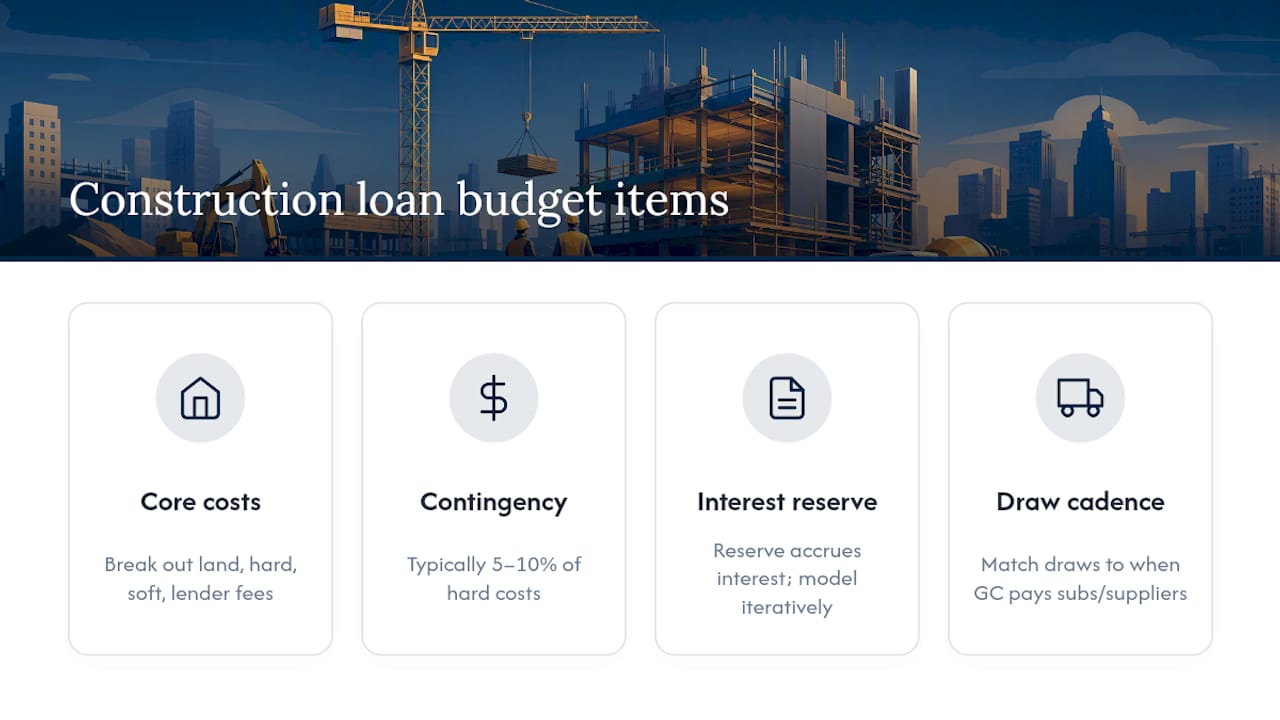
Your sources and uses statement should break out land or acquisition cost, hard costs, soft costs (architecture, engineering, permits), lender fees, contingency, and the interest reserve as separate line items. Contingency typically runs 5 to 10 percent of hard costs, more for renovation projects where hidden conditions are common.
Here’s where a lot of investors underfund their deal: they assume the loan balance averages 50 percent outstanding across the construction term and size the interest reserve accordingly. That shortcut usually understates the real number.
Pro Tip: Vertical construction draws almost always follow an S-curve, slow at the start, heavy in the middle, tapering at the finish. A draw-by-draw model that reflects that curve produces a higher average outstanding balance than a flat 50 percent assumption, which means the naive shortcut leaves your reserve short right when you need it most.
There’s also a circularity problem worth knowing about: interest accrues on the drawn reserve itself, so the reserve calculation feeds back into the loan amount. Practitioners resolve this with iterative modeling rather than a single fixed percentage.
On the operational side, align your draw cadence with when your GC actually owes subcontractors and suppliers. A draw schedule that’s out of sync with payment obligations creates cash-flow gaps that have nothing to do with the total loan amount and everything to do with timing.
What Belongs in Every Draw Request?
Getting draws funded fast is mostly about anticipating what the lender’s inspector and underwriter need before they ask for it.
- AIA G702/G703 forms (or the lender’s equivalent) showing cost-to-date against the SOV.
- Contractor and subcontractor invoices matched to the line items being drawn.
- Conditional and unconditional lien waivers from every party paid in the prior draw.
- Date-stamped progress photos covering each major line item.
- An updated schedule and remaining budget-to-complete.
Complete packages typically process in 5 to 14 business days; incomplete ones routinely add weeks. Coordinate your GC’s billing cycle with the lender’s inspection window so the site is ready to inspect the day the draw request goes in, not a week later. Organize lien waivers as a standing part of your payment process rather than scrambling for them after the fact. That single habit prevents most funding holdbacks.
How Do You Plan the Permanent Takeout Before You Break Ground?
Lenders want to know how you’re getting out of the construction loan before they’ll fund the first draw. That’s the takeout plan, and it comes in two flavors: a committed takeout, where a permanent lender has issued a formal commitment or letter, and an assumed refinance, where you’re betting a permanent loan will be available at stabilization without a signed agreement.
- Securing a committed takeout before breaking ground reduces construction pricing and cuts friction at closing, since the construction lender’s risk drops the moment there’s a confirmed exit.
- Common permanent products for stabilized rental investors include DSCR refinance loans, agency multifamily debt, and portfolio refinances through a bank or credit union.
- Lenders at the takeout stage look for stabilized occupancy, a debt yield that clears their minimum, and an appraisal that supports the new loan amount.
- Two pitfalls show up constantly: seasoning requirements that force you to hold the completed property for a set period before refinancing, and appraisal shortfalls where the finished value comes in below projections.
Running your numbers through a DSCR loan calculator before you finalize your construction budget gives you an early read on whether your projected rents will support the refinance you’re counting on.
What Risks Should Investors Watch For, and How Do You Mitigate Them?
Three risk categories account for most failed construction projects that had adequate capital going in.
- Cash-flow risk from delayed draws or an underfunded interest reserve. Mitigate it by modeling draws on the S-curve, not the 50 percent shortcut, and keeping a cash buffer beyond the reserve.
- Documentation risk from an incomplete SOV or missing lien waivers. The single best prevention tactic is owner-controlled draw administration: one person tracking every invoice, waiver, and photo against the SOV before submission, rather than relying on the GC to self-report.
- Takeout risk at stabilization, when rates have moved or the appraisal disappoints. Underwrite your exit conservatively from day one, using a debt yield and rate assumption with margin built in, not the best-case scenario.
None of these risks are exotic. They’re the same three issues that show up in nearly every stalled construction project, which is exactly why they’re worth planning around before the first draw request goes out.
How Surge Financial Supports Investor Construction Financing
Packaging a construction loan submission that survives underwriting takes real coordination between your SOV, GC contract, and capital sources. Surge Financial works with real estate investors to simplify that process, matching each project with lenders suited to ground-up construction, rehab, or bridge-to-construction structures, without upfront fees or hard credit pulls.
The flow is straightforward: intake and document review, a lender match based on your project profile and sponsor strength, then funding, typically within 1 to 3 business days once terms are agreed. Surge Financial has facilitated more than $2 billion across 500-plus deals, working across property types from single-family rentals to multifamily developments.
What Are the Tax Implications of Construction Financing for Investors?
Construction loan interest on an investment property is generally deductible, but the timing depends on how the IRS treats the property during the build. Interest paid during active construction on a property held for investment is typically added to the property’s basis rather than deducted immediately, under capitalization rules that apply to real property under construction.
That distinction matters for your cash planning even though it doesn’t change your actual cash outflow. You’re still paying interest out of the reserve every month. You just may not get to deduct it the year you pay it. Once the property is placed in service, meaning it’s ready and available for its intended use as a rental, ongoing mortgage interest on the permanent loan becomes deductible as a normal operating expense against rental income.
Depreciation only starts once the property is placed in service, not during construction, so the build period is effectively a tax-deferred zone where you’re carrying costs without offsetting deductions. Investors who structure a project through an LLC or other pass-through entity should coordinate with a CPA on how capitalized interest interacts with basis calculations at sale, since it affects your gain calculation down the line.
None of this is a reason to avoid construction financing. It’s a reason to loop in a tax professional before you break ground, not after your first Schedule E filing. The rules around capitalized interest and placed-in-service timing are specific enough that a general contractor’s advice or a forum post isn’t a substitute for someone who knows your full tax picture.
What Documents Do Investor Construction Loans Require That Owner-Occupied Loans Don’t?
Owner-occupied construction loans focus heavily on the borrower’s personal income and intent to occupy. Investor construction loans shift that focus almost entirely onto the deal itself and the sponsor’s track record as an operator.
Expect to provide a full sponsor financial package: personal financial statements, liquidity verification, and a schedule of real estate showing every property you own or have owned, along with how those deals performed. Lenders want proof you’ve completed projects of similar size and scope before, not just proof you can make a mortgage payment. If you’re borrowing through an entity, expect to provide the operating agreement, articles of organization, and a personal guarantee from each principal.
On the project side, investor loans require a rent roll or market rent analysis supporting your stabilized income projections, since that number drives both the takeout sizing and the lender’s confidence in your exit. You’ll also need a detailed construction budget broken into the same line items as your SOV, a contingency line explicitly called out rather than buried in soft costs, and evidence of builder’s risk insurance naming the lender as an additional insured.
Multi-property or portfolio investors often need to disclose other outstanding construction loans and their draw status, since lenders want to know if your liquidity is already stretched across other active builds. If you’re relying on a committed takeout, the lender will want that commitment letter in hand, not just a verbal assurance from your mortgage broker. The overall documentation burden is heavier than an owner-occupied loan specifically because the lender is underwriting a business plan, not a household budget.
How Do Market Conditions Affect Construction Loan Availability for Investors?
Construction lending tightens and loosens with the broader credit cycle faster than most other real estate loan categories, because construction debt carries more execution risk than a stabilized asset loan. When rates rise or bank balance sheets get stressed, construction lenders are typically among the first to pull back leverage, raise spreads, or add covenants.
Rate movements affect two things simultaneously: your carrying cost during the build and your takeout economics at the end. A rate environment where SOFR-based construction spreads sit at 275 to 400 basis points means your interest reserve needs recalculating any time the underlying index moves meaningfully between application and closing.
Bank retreat from construction lending, which happens periodically as regulators scrutinize concentration in commercial real estate, tends to push more deal flow toward private credit and debt funds. Those sources often move faster and underwrite with more flexibility on sponsor experience, but they generally price higher than a bank facility would. Investors who can show a committed takeout and a conservative contingency line have consistently better luck getting funded through tighter credit windows, because that’s precisely the risk lenders are trying to price around.
The practical takeaway is that timing your application to broader credit conditions matters almost as much as timing it to your own project readiness. A well-packaged deal submitted during a tight lending window still competes for capital against every other sponsor doing the same thing, which is exactly why the underwriting checklist covered earlier isn’t optional busywork. It’s the difference between getting a term sheet in a tough market and getting passed over.
A Practitioner’s Bottom Line on Investor Construction Loans
Lock your takeout before you lock your GC contract. That single sequencing decision solves more construction financing problems than any spreadsheet trick. Your SOV and GMP contract deserve as much attention as your rate quote, since a sloppy SOV kills draws faster than a bad rate ever will.
Before you submit anywhere, confirm you have: a real sources and uses model, a complete SOV, a signed GC contract, your Phase I and geotech reports, an interest reserve calculated draw-by-draw, and either a takeout commitment or an active conversation with a permanent lender. Six items, no shortcuts.
— Brandon
Ready to Package Your Construction Loan? Talk to Surge Financial
Building the sources and uses model, chasing a GC contract, and lining up a takeout lender all at once is a lot to coordinate solo, especially on your first ground-up deal. Surge Financial’s capital advisors handle that coordination directly, reviewing your project package and matching you with lenders suited to ground-up construction, rehab, or bridge-to-construction structures, without upfront fees or a hard credit pull slowing you down.

That consultative model is why Surge Financial has facilitated more than $2 billion across 500-plus closed deals, spanning single-family rentals, multifamily builds, and commercial projects. If you’re an investor with a project package coming together, or one still taking shape, visit Surge Financial’s ground-up construction financing page to connect with a capital advisor and find out which lenders fit your deal.
This article is general information, not a substitute for advice from a qualified financial advisor. Consult a qualified financial professional about your own circumstances before acting on anything here.
Sources
- Draw Schedules: Streamlining Construction Finance | Procore
- Construction Loan Draw Management Guide | Projul
- Construction loans, draw schedules, and interest reserves | APERS
Recommended
Get Started with Surge Financial
Talk to a dedicated Surge Financial advisor. No hard credit pull, no upfront fees, and you see every option before deciding.
Get Started →