
market. Plan on a baseline down payment that is considered typical, with most deals actually closing within a moderate range above that baseline. And down payment is just one piece of what you'll need at the closing table.
***
> TL;DR: > > - Most DSCR loans typically require a down payment of around 20%, with higher amounts necessary if DSCR drops below 1.10 or credit scores are lower. > - Factors such as property type, state overlays, and short-term rental income can increase the minimum down payment required for approval. > - Reserves generally range from three to six months of PITIA, and must be liquid, seasoned, and prove sufficient for the loan to fund smoothly. > - Down payment alone is not your total cash to close; closing costs and reserves significantly add to your initial out-of-pocket expenses. > - Matching your specific loan parameters to the right lender overlay is crucial, and working with an advisor can optimize your down payment and total cash to close.
***
Table of Contents
- How Much Down Payment Does a DSCR Loan Require?
- What's the Typical Down Payment Range for DSCR Purchases?
- Which Underwriting Factors Move Your Down Payment Requirement?
- Down Payment Is Not Your Total Cash to Close
- Legitimate Ways to Lower Your Out-of-Pocket Cash
- How Does a DSCR Cash-Out Refinance Fund Your Next Down Payment?
- How Do You Calculate Your Required Down Payment Before Making an Offer?
- Surge Financial's Perspective on Down Payment Flexibility
- The Real Down Payment Conversation Investors Aren't Having
- Plan Your DSCR Down Payment With an Advisor Who Knows the Overlays
- Where to Verify These Underwriting Facts
- Sources
How Much Down Payment Does a DSCR Loan Require?
The number that matters most on a DSCR loan isn't your income. It's the property's own cash flow.
DSCR stands for debt service coverage ratio, calculated as monthly rent divided by monthly PITIA (principal, interest, taxes, insurance, and association dues). A property generating $2,500 in rent against a $2,000 PITIA payment has a 1.25 DSCR. Lenders underwrite that ratio, not your W-2 or tax returns, which is exactly why DSCR loans exist for investors who don't want to document personal income at all.
That structural difference explains why the down payment can't drop to zero. A bigger down payment shrinks the loan amount, which lowers the monthly principal and interest, which pushes the DSCR up. Down payment isn't a bureaucratic formality here. It's the lever that makes the ratio work.
Three forces keep DSCR purchase loans away from low or no down payment structures:
- The lender has no income backstop. Since qualification skips personal income verification, the property's equity cushion is the primary protection against default.
- Loan sizing depends on rent, not the borrower. A thin down payment often pushes DSCR below 1.00, and most programs won't approve a deal there without serious compensating factors.
- Regulatory guidance around commercial-style lending reinforces this. The Comptroller's Handbook on Commercial Real Estate Lending frames sound underwriting around collateral quality and borrower liquidity rather than income documentation, which is the same logic DSCR programs apply at the retail level.
That's the mechanical reason "no money down" DSCR offers you might see advertised almost always describe something other than a straight purchase loan.
What's the Typical Down Payment Range for DSCR Purchases?
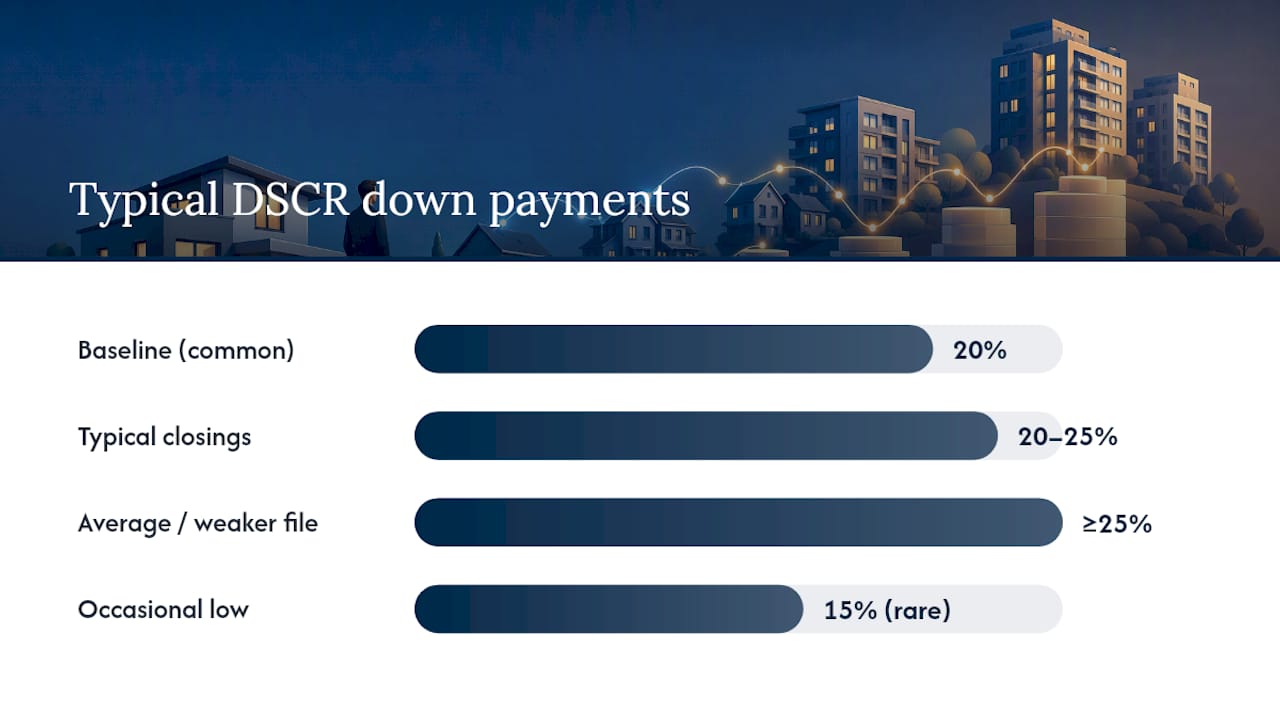
A down payment around one-fifth of the purchase price is commonly expected across most DSCR programs under typical qualification conditions, including adequate DSCR, good credit, and standard loan sizes. That's the number to build your offer math around.
In practice, most closings land within a moderate range above the baseline down payment. Lenders may require a higher down payment when factors in the loan file are average rather than strong.
> Down payment reality check: A single-family rental with a 1.15 DSCR and a 720 credit score will typically clear at 20% to 25% down. Drop the DSCR to 1.05 or the credit score into the mid-600s, and the same lender may require 25% or more to keep the deal approvable.
A down payment near 15% can sometimes be achieved, but it is an uncommon exception that depends on several strong factors aligning simultaneously.
- DSCR comfortably above 1.25, giving the lender a real income cushion
- Credit score well into the 740+ range
- Reserves that exceed what the lender minimally requires
- A straightforward single-family or small multifamily property with no overlay flags
- Unit count. Two to four unit properties often carry a higher down payment floor than single-family rentals, since vacancy risk on one unit affects the whole PITIA calculation.
- Property type. Condos and condotels frequently get treated more conservatively; condotels in particular can trigger additional underwriting scrutiny.
- State overlays. Certain states, including Connecticut, Florida, Illinois, New Jersey, and New York, have specific program overlays on some DSCR products that raise minimum equity requirements.
- Short-term rental income. Lenders financing an Airbnb or short-term rental typically apply an income haircut, which can indirectly increase the effective down payment needed to hit the target DSCR.
If your target market carries state-specific overlays, checking a Florida DSCR loan program page (or the equivalent for your state) before you write an offer saves you from a rate lock surprise two weeks before closing.
Which Underwriting Factors Move Your Down Payment Requirement?
Down payment on a DSCR loan isn't a fixed number pulled from a rate sheet. It moves based on five interacting variables, and understanding each one tells you exactly where to focus if you want to bring less cash to the table.
- DSCR ratio itself. Below 1.00, many programs either decline the file or demand meaningfully more equity to offset the shortfall. At exactly 1.00, you typically qualify at standard terms. Push the ratio to 1.10 through 1.25 or higher, and you often unlock better leverage, sharper pricing, or both.
- Credit score tier. Pricing and minimum down payment shift in bands roughly across 640, 680, 720, and 760-plus. A borrower at 760 might see meaningfully better terms than one at 660 on an identical property, even with the same DSCR.
- Property type and income treatment. Standard single-family and small multifamily properties get the most favorable treatment. Short-term rentals commonly face an income haircut of around 20% when lenders calculate qualifying rent, which effectively raises the bar for reaching your target DSCR at a given down payment.
- Loan size and geography. Larger loan amounts sometimes carry higher down payment floors, and state overlays can add requirements regardless of how strong the rest of the file looks.
- Seasoning on funds and on the deal itself. Lenders want to see that down payment funds have sat in your account long enough to rule out an undisclosed loan propping up the purchase.
Pro Tip: *If your DSCR is sitting right at 1.00, don't try to fix it by shopping for a lower rate.
Reserves interact with all of this in a way many first-time DSCR borrowers miss. Reserves and down payment aren't separate boxes to check. They're two inputs the underwriter weighs together.
Down Payment Is Not Your Total Cash to Close
Down payment is the headline number, but it's rarely the full check you write at closing. Reserves and closing costs sit on top of it, and skipping that math is the single most common budgeting mistake investors make on their first DSCR deal.
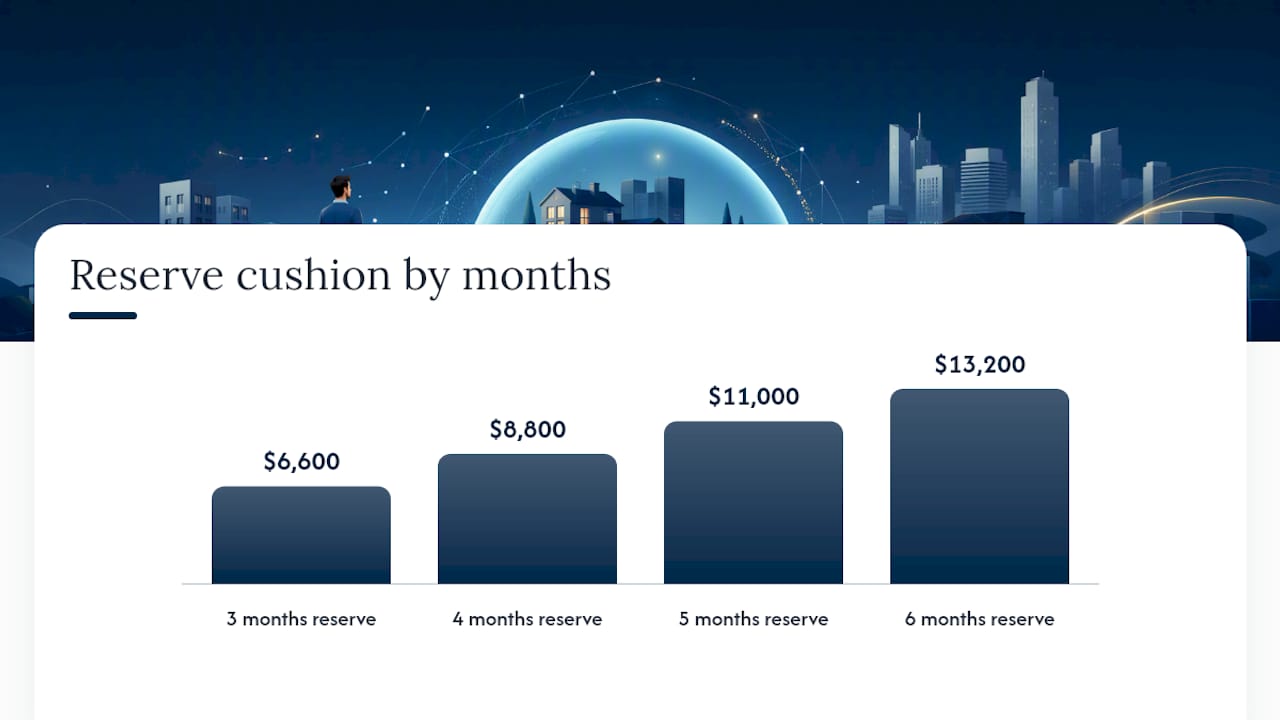
Reserve requirements commonly range from a few months of PITIA, with about half a year serving as a common middle-market expectation on many programs. Larger loan amounts, weaker DSCR, or a first-time investor profile can push that reserve requirement higher.
Here's what "reserves" actually means in underwriting terms, step by step:
- Calculate your monthly PITIA for the property you're financing.
- Multiply by the required reserve months (commonly three to six).
- Verify the funds are liquid and seasoned, typically shown through two to three months of consistent bank statements.
- Confirm the funds remain post-closing, separate from the down payment and closing costs, not double-counted.
A quick sketch: a property with $2,200 monthly PITIA and a six-month reserve requirement means $13,200 sitting untouched, in addition to whatever you put down and whatever you pay in closing costs.
> Lenders generally will not credit reserves that appear in your account the week before closing without a documented, seasoned source. A large deposit with no paper trail is one of the fastest ways to stall a file at the finish line.
Documentation lenders commonly request includes two to three months of bank statements, entity formation documents if you're closing in an LLC, an EIN letter, and sometimes a letter explaining any large or unusual deposits. None of this is unique to DSCR loans, but investors moving from conventional financing are often surprised by how closely reserves get scrutinized on a business-purpose loan.
Legitimate Ways to Lower Your Out-of-Pocket Cash
You can reduce the cash you personally bring to a DSCR closing without misrepresenting anything on your application. The tactics below are the ones that actually hold up under underwriting, as opposed to the vague "no money down" pitches that tend to describe a different product entirely.
- DSCR cash-out refinance or delayed financing. If you bought a property with cash or a bridge loan, you can often refinance into a DSCR loan and pull equity back out to fund your next down payment, a core mechanic of the BRRRR strategy (buy, rehab, rent, refinance, repeat).
- Seller credits. A seller-paid credit toward closing costs can free up cash you'd otherwise need for prepaids or fees, though it typically can't be applied directly to your required down payment.
- Seller-carried second liens. Some deals use a seller second to cover part of the equity gap, but most DSCR lenders cap how much of the required down payment can come from a subordinate lien, and some prohibit it outright.
- Partner capital. Bringing in a capital partner who contributes part or all of the down payment is common and generally accepted, provided the partnership structure and funds are documented.
- Gift funds. These are far more restricted on business-purpose DSCR loans than on owner-occupied conventional loans, and many programs don't allow gifted funds to satisfy the borrower's required contribution at all.
- Investor HELOCs and bridge loans. Tapping a HELOC or bridge facility on an existing property to cover a down payment, then later refinancing that property or the new one into permanent DSCR financing, is a widely used interim strategy.
Any offer promising zero-down DSCR purchase financing with no strings attached deserves a hard second look. The FBI's guidance on mortgage fraud flags exactly this pattern: financing structures that hide the true source of funds or misstate the terms of a transaction. Legitimate "less money down" strategies are always documentable. If a lender or broker can't explain in plain terms where the equity is actually coming from, walk away.
How Does a DSCR Cash-Out Refinance Fund Your Next Down Payment?
Turning equity in one rental into the down payment for the next one is one of the most reliable ways experienced investors scale a portfolio without saving a new lump sum for every deal. The process follows a consistent sequence.
- Order an appraisal on the property you plan to refinance, since your cash-out amount depends entirely on current market value, not your original purchase price.
- Calculate the new PITIA at the loan amount you're targeting under the new terms.
- Run the DSCR test to confirm the property's rent still supports the new, larger payment at the cash-out loan amount.
- Calculate payoff and net proceeds, subtracting your existing loan balance, closing costs, and any prepayment penalty from the new loan amount.
Cash-out LTV ceilings on DSCR loans run tighter than purchase LTVs. Seasoning, meaning how long you've owned the property before a lender will let you refinance based on new appraised value, typically runs three to six months. Delayed financing is a notable exception: if you bought with cash, some programs let you refinance sooner, using the original purchase price as a ceiling rather than waiting out full seasoning.
Two costs quietly shrink your net proceeds:
- Rate premium. Cash-out refinances typically price slightly higher than purchase-money DSCR loans, reflecting the added risk lenders take on. The FRED 30-year mortgage rate series is a useful benchmark for tracking the baseline rate environment your cash-out pricing will sit above.
- Prepayment penalties. Many DSCR loans carry a prepayment penalty structure, which can eat into proceeds if you refinance again too soon after the original closing.
Pro Tip: Run the DSCR test at your target cash-out amount before you order the appraisal, not after. If the math doesn't clear 1.00 at the LTV you want, you'll know to request a lower cash-out amount instead of paying for an appraisal on a refinance that won't close as planned.
How Do You Calculate Your Required Down Payment Before Making an Offer?
Running the numbers before you write an offer, rather than after, is what separates investors who close smoothly from those who scramble for cash mid-escrow. Here's the order of operations.
- Gather your property inputs: expected monthly rent, property taxes, insurance premium, and HOA dues if applicable.
- Estimate principal and interest at your target loan-to-value using current DSCR loan pricing, which you can rough out with a DSCR loan calculator.
- Add P&I to taxes, insurance, and HOA to get your full PITIA.
- Divide rent by PITIA to get your DSCR at that down payment level.
- Adjust the down payment up or down and recalculate until you land at your target ratio, generally 1.10 or higher for the most comfortable pricing.
- Layer in your credit tier to sanity-check whether that down payment level actually matches current program minimums for your score.
- Set a reserve objective, typically three to six months of the PITIA you just calculated.
Before you approach a lender, assemble two to three months of bank statements, entity formation documents and an EIN letter if you're closing in an LLC, and proof that your reserve funds are seasoned and liquid. If your numbers are close but not quite clearing your target ratio, that's the point to bring in a capital advisor who can run multiple lender scenarios at once rather than guessing which program fits.
Get Started with Surge Financial
Talk to a dedicated Surge Financial advisor. No hard credit pull, no upfront fees, and you see every option before deciding.
Get Started →