
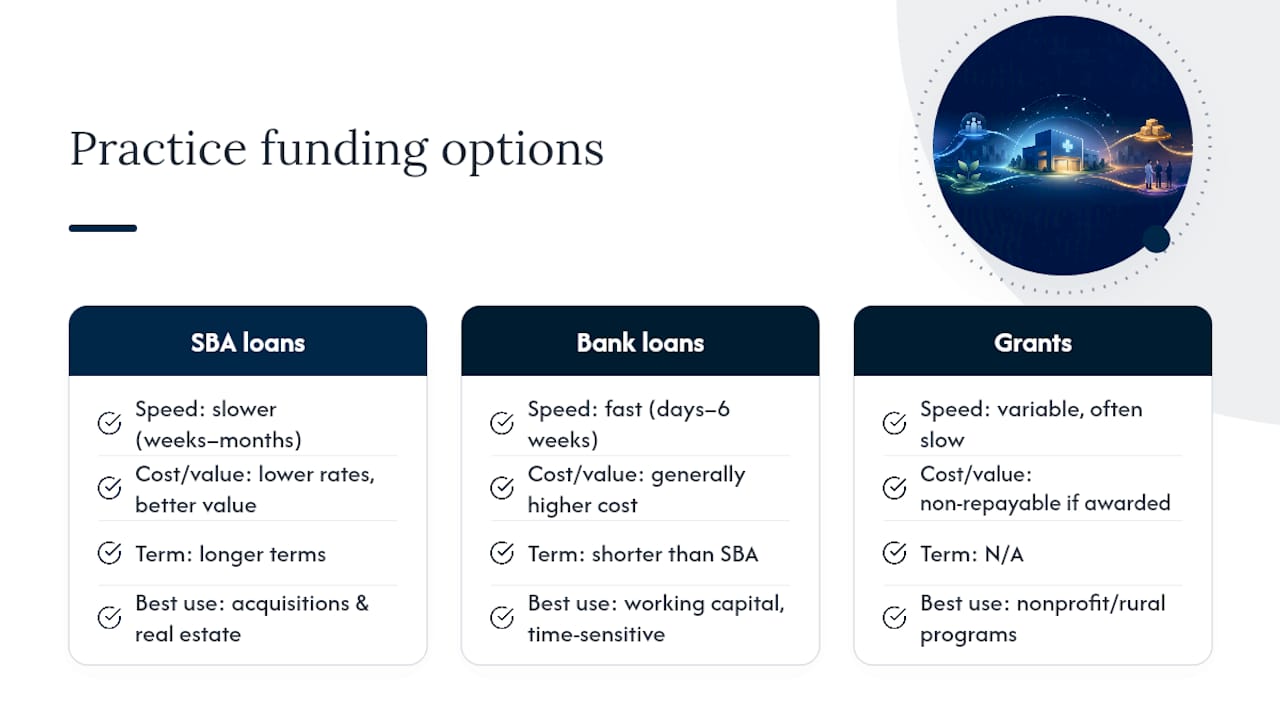
For acquisitions and commercial real estate, SBA-backed loans usually deliver the best long-term value. For fast working capital or a short-term bridge, a bank practice loan or an alternative capital solution gets money in your account faster. For equipment, dedicated equipment financing almost always beats general-purpose credit. The trade-off runs in one direction: speed costs money, and value costs time. Online and revenue-based lenders can fund a request in days but charge for that convenience. SBA loans and commercial bank practice loans generally take longer but tend to offer lower rates and longer terms.
Before you contact anyone, gather your last two to three years of tax returns, a current financial statement, your business plan, and any lease or purchase agreement tied to the deal. Then talk to a practice finance specialist or capital advisor who can match your goal to the right product instead of the first one offered.
- Startup or new build: SBA 7(a)/504 or a bank practice loan
- Acquisition or buy-in: SBA loan or conventional bank financing
- Equipment purchase: equipment financing or leasing
- Working capital or bridge: bank line of credit or short-term alternative funding
Pro Tip: Ask any lender directly whether they have a dedicated “medical” or “practice finance” underwriting track. Generalist small-business lenders often misjudge how quickly a clinical practice generates cash flow once it opens.
Key Takeaways
The right way to fund a medical practice depends on matching your specific goal, whether startup, acquisition, equipment, or working capital, to the financing product built for that purpose rather than defaulting to whichever lender responds first.
| Point | Details |
|---|---|
| Match product to goal | Use SBA loans for acquisitions and real estate, equipment financing for capital purchases, and lines of credit for working capital. |
| SBA costs less but takes longer | Expect 60 to 120+ days for SBA approval versus two to six weeks for a bank practice loan. |
| Credit profile drives pricing | A stronger personal and business credit score reduces rates and lessens reliance on a personal guarantee. |
| Budget after funding, not just before | Build a cash-flow forecast and a three-to-six-month reserve before treating revenue as discretionary. |
| Compare offers through Surge-financial | Surge-financial matches practices with suitable lenders across SBA, equipment, and working capital products, often funding within 1 to 3 business days. |
Table of Contents
- What Types of Financing Are Available to Fund a Medical Practice?
- SBA Loans vs. Bank Practice Loans: Which Should You Choose?
- When Should You Use Alternative or Short-Term Financing?
- What Do Lenders Look For When You Apply to Fund a Clinic?
- What Documents and Timeline Should You Expect?
- How Do You Prepare, Apply, and Negotiate Financing Successfully?
- How Does Surge Financial Help You Fund a Medical Practice?
- How Do Personal and Business Credit Scores Affect Your Financing Options?
- What Tax Implications Come with Different Financing Methods?
- How Do You Negotiate Loan Terms and Manage Debt Effectively?
- How Should You Plan and Budget After Funding a Practice?
- A Practitioner-First Take on Financing Your Practice
- Get Matched With the Right Financing for Your Practice
- Authoritative Resources for Planning Your Practice Financing
- Frequently Asked Questions
- Sources
What Types of Financing Are Available to Fund a Medical Practice?
Medical practice financing breaks into five broad categories, and most successful funding plans combine at least two of them.
Bank practice loans are the workhorse product for most clinicians. These come from national and regional banks with dedicated healthcare lending teams, and they often include interest-only periods during buildout or transition, plus terms structured around a clinician’s income trajectory rather than a typical small-business profile. U.S. Bank’s practice financing program, for example, offers terms typically extend to long durations for general practice loans and longer periods for commercial real estate.
SBA loans (7(a) and 504) suit borrowers who want the lowest realistic cost of capital and can tolerate a longer approval timeline. They shine for acquisitions, ground-up construction, and large real estate purchases.
Equipment financing and leasing let you finance imaging machines, dental chairs, or lab equipment against the asset itself, often with less scrutiny of your overall balance sheet than a general loan.
Business lines of credit cover payroll gaps, seasonal slowdowns, or unexpected repairs without the overhead of a term loan.
Short-term alternatives, including merchant cash advances and revenue-based financing, deliver capital fast but at a real cost premium. They work best as a bridge, not a foundation.
- Bank practice loans: tailored terms, interest-only options, relationship banking
- SBA 7(a)/504: lowest cost, longest terms, slowest approval
- Equipment financing: asset-secured, faster underwriting
- Lines of credit: flexible, revolving, ideal for cash-flow gaps
- Alternative funding: fast but expensive, best for short bridges
SBA Loans vs. Bank Practice Loans: Which Should You Choose?
The SBA 7(a) program covers the widest range of uses, including working capital, acquisition, refinancing, and equipment, with loan amounts up to $5 million and government guarantees that make banks more willing to lend to newer practices. The CDC/504 program is built specifically for major fixed assets like real estate and large equipment, typically with a lower down payment and a long-term fixed rate on the real estate portion. Both programs draw on SBA size-standard and eligibility guidance that lenders use during underwriting, so knowing where your practice falls before you apply saves real time.
Bank practice loans move faster. A bank with a dedicated healthcare lending desk can often turn around a decision in weeks rather than months, and many offer practice specialists who understand clinical revenue cycles, insurance reimbursement lag, and buy-in structures that a generalist loan officer would flag as risk.
- SBA 7(a): flexible use, significant loan amounts available, slower close
- SBA 504: real estate and major equipment, lower down payment
- Bank practice loans: faster, relationship-driven, specialist support
- Blended approach: SBA for the building, a practice line for working capital
Pro Tip: If your total financing need spans both real estate and day-to-day cash flow, ask your lender about splitting the request. Financing the building through SBA 504 while covering working capital through a conventional practice line often lowers your blended cost of capital more than forcing everything into one loan type.
When Should You Use Alternative or Short-Term Financing?
Merchant cash advances and revenue-based financing exist for one purpose: speed. A clinic facing a payroll shortfall or an unexpected equipment failure can often get funded within a day or two, with repayment tied to a percentage of daily card receipts or bank deposits. That convenience comes at a steep price. Effective annual costs on these products frequently run far above what a term loan or line of credit would charge, because the underwriting leans on cash-flow patterns rather than credit history.

Online term loans and short-term lines sit a notch below that in cost but still price in speed and lighter documentation requirements compared with a bank.
Equipment loans and leases remain the more targeted, lower-cost route whenever the funding need is tied to a specific purchase rather than general cash flow.
- Merchant cash advance: fastest, most expensive, daily repayment
- Revenue-based financing: fast, flexible repayment tied to receivables
- Online term loans: moderate speed, moderate cost, lighter paperwork
- Equipment financing: targeted, asset-secured, generally cheaper than unsecured alternatives
Pro Tip: Treat any short-term product as a bridge with a defined exit. If you can’t answer “how does this get refinanced into cheaper capital within 12 to 18 months,” it’s the wrong tool for the job.
What Do Lenders Look For When You Apply to Fund a Clinic?
Lenders evaluate medical practice applications differently depending on whether you’re a first-time owner or an established group, but the core priorities stay consistent.
- Credentials and licensing. Lenders verify active state licensure, board certification where relevant, and malpractice insurance before they look at anything else.
- Personal and business credit. Your personal credit score still carries significant weight for a startup practice, since there’s no business history to lean on. Established practices are judged more on business credit and debt-service coverage.
- Revenue history and projections. Existing practices submit trailing financials; startups submit pro forma projections built on realistic patient-volume and reimbursement assumptions.
- Collateral and guarantees. Real estate, equipment, and a personal guarantee are standard for practice loans, particularly at the startup stage.
- Structure for new grads and associates. A recent graduate without a credit or revenue history can still qualify through a co-borrower, a signed buy-in or partnership agreement, or a seller-financed note paired with a smaller bank loan.
What Documents and Timeline Should You Expect?
Every lender asks for a version of the same core packet, so building it once saves you from scrambling later.
- State medical license, DEA registration if applicable, and board certifications
- Professional CV and malpractice history
- Business plan with financial projections, following the structure outlined in SBA’s business plan guidance
- Two to three years of personal and business tax returns
- Personal financial statement and business balance sheet
- Signed lease, purchase agreement, or letter of intent
- Equipment quotes for anything being financed directly
Timelines vary sharply by product. Alternative lenders can fund in a matter of days. Bank practice loans typically close in two to six weeks. SBA loans, given the added government review layer, often take 60 to 120 days or longer, especially for 504 real estate deals.
Cost depends heavily on your credit profile, available collateral, term length, and lender type. As a rough example, a $400,000 equipment loan at a mid-single-digit rate over seven years lands in a very different monthly payment range than the same balance financed through a 12-month alternative product. Build a cash-flow model before you apply so you can show a lender exactly how the new payment fits your existing revenue.
How Do You Prepare, Apply, and Negotiate Financing Successfully?
- Define your objective first. Acquisition, new build, equipment, or working capital each points toward a different primary product.
- Assemble your documents and business plan using the SBA’s planning framework as your structural guide.
- Get at least two term sheets — one from a bank practice specialist, one from a capital advisor with access to multiple lenders — so you have real numbers to compare.
- Negotiate the terms that matter most: interest rate, term length, prepayment penalties, and what collateral the lender actually requires.
- Confirm closing conditions in writing before you commit to anything, including any financial covenants tied to the loan.
- After closing, build a monitoring routine for cash flow and set aside a contingency reserve for the first six to twelve months.
Pro Tip: Never negotiate rate in isolation. A slightly higher rate with no prepayment penalty and a longer interest-only period can beat a lower rate that locks you into rigid terms during your slowest growth months.
How Does Surge Financial Help You Fund a Medical Practice?
Surge Financial has facilitated a substantial volume of funding across numerous closed deals, working with business owners and investors, including healthcare clinics, who need a clear path to capital instead of a maze of separate lender applications. The process starts with a consultative review of your situation, moves through matching you with appropriate funding sources, and typically results in funding within 1 to 3 business days once terms are agreed, all without upfront fees.
That speed matters most when you’re facing a complex acquisition, a tight closing deadline, or a financing need that blends more than one product, real estate plus equipment plus working capital, for example. Approaching multiple banks separately for that kind of blended deal can burn weeks you don’t have.
A capital advisor’s job isn’t to replace your bank relationship. It’s to give you a comparison point, so you know whether the offer in front of you is actually competitive before you sign.
Reach out when your situation calls for speed and access to more than one lending source at once.
How Do Personal and Business Credit Scores Affect Your Financing Options?
Your personal credit score carries outsized weight for a startup practice with no operating history, and most banks want to see a score in the high 600s or better before offering favorable terms on a practice loan. Below that threshold, doors don’t close entirely, but pricing gets worse and collateral requirements get stricter.
Once a practice has been operating for a few years, business credit starts to matter more. Lenders look at your business credit profile, payment history on existing trade lines, and debt-service coverage ratio, which measures how comfortably your cash flow covers debt payments. A strong personal score paired with a thin business credit file is common for newer practices and usually gets treated as a startup case regardless of how the paperwork is framed.
The practical impact shows up in three places: approval odds, interest rate, and how much personal guarantee a lender demands. A physician with a 750 personal score and steady W-2 or 1099 income before opening a practice will typically see meaningfully better pricing than one in the mid-600s, even when both are applying for the identical loan amount. Business credit, once established, can eventually reduce reliance on a personal guarantee, though most practice loans still require one regardless of business credit strength. Checking both reports before you apply, and correcting any errors, is one of the simplest things you can do to improve your offers.
What Tax Implications Come with Different Financing Methods?
Debt financing, whether an SBA loan, a bank practice loan, or equipment financing, generally allows you to deduct the interest portion of your payments as a business expense, which lowers your effective borrowing cost compared with the stated rate. Equipment purchased through a loan or certain lease structures may also qualify for accelerated depreciation, letting you write off a large share of the cost in the year you place the equipment in service rather than spreading it over many years.
Leasing equipment instead of buying carries a different tax profile. Operating leases are often deducted as a straightforward business expense, while finance leases get treated more like a purchase for tax purposes. Which structure benefits you more depends on your practice’s income timing and your accountant’s read on current depreciation rules, so this is a conversation to have before you sign, not after.
One financing route carries a distinct tax dimension: Rollovers as Business Start-ups, or ROBS, let you fund a practice using retirement account funds without triggering the early withdrawal penalty or immediate income tax that a typical 401(k) withdrawal would trigger. The IRS treats ROBS as a compliance-sensitive structure with specific procedural requirements, and getting it wrong can unwind the tax advantage entirely. Anyone considering ROBS should work with a specialist familiar with the exact IRS steps, not a general accountant handling it as a side project.
How Do You Negotiate Loan Terms and Manage Debt Effectively?
Negotiating a practice loan starts with getting more than one offer on the table. A single term sheet gives you nothing to compare against, but two or three, ideally spanning a bank practice specialist and a capital advisor with multiple lender relationships, gives you real leverage on rate, term, and fees.
Rate is the number everyone focuses on, but it’s rarely the only lever worth pulling. Prepayment penalties can cost you far more than a slightly higher rate if you plan to refinance or sell within a few years. Interest-only periods during a slow ramp-up phase can be worth more than a rate discount if your first year of revenue is uncertain. Collateral requirements are also negotiable, particularly with community banks, which tend to offer more flexible underwriting than larger institutions because of closer local relationships.
Once the loan closes, managing the debt matters as much as securing favorable terms. Prioritize paying down higher-cost, shorter-term obligations first, especially any bridge or alternative financing used during the transition. Keep a running comparison of your actual debt-service coverage against projections, and refinance opportunistically if your credit profile or business credit improves within the first two to three years. A practice that stacks multiple loans without a repayment sequence in mind often ends up paying more in blended interest than one that consolidates deliberately.
How Should You Plan and Budget After Funding a Practice?
Getting funded is the beginning of the financial work, not the end of it. The first ninety days after closing should include building a rolling cash-flow forecast that accounts for the realistic lag between seeing patients and collecting insurance reimbursement, which can stretch 30 to 60 days depending on your payer mix.
Set aside a cash reserve, ideally three to six months of fixed operating costs, before you start treating surplus revenue as discretionary. New practices in particular tend to underestimate ramp-up time and overcommit to staffing or marketing spend before patient volume catches up.
Build your loan payments into a budget that separates fixed obligations (loan payments, rent, payroll base) from variable costs (supplies, part-time staffing, marketing) so you can see quickly where you have flexibility if a slow month hits. Revisit your budget quarterly against actual performance rather than annually. A practice that only checks its numbers once a year typically discovers problems six months after they could have been fixed. If your financing includes any covenants, such as a minimum debt-service coverage ratio, track that number monthly, not just at renewal time, so you’re never caught off guard by a lender conversation you didn’t see coming.
A Practitioner-First Take on Financing Your Practice
Most advice on funding a medical practice treats every borrower the same, as if a first-year associate buying into a group and a fifteen-year veteran building a second location need the same playbook. They don’t. The single biggest mistake I see clinicians make isn’t choosing the wrong lender, it’s optimizing for the lowest headline rate without weighing how long they’ll actually hold the debt.
If you’re financing real estate or an acquisition you plan to keep for a decade, SBA financing is worth the longer timeline almost every time. If you’re bridging a six-month gap, chasing that same low rate through a slow SBA process can cost you more in lost time and opportunity than a faster, pricier alternative would have.
The other overlooked piece is credit hygiene. Clinicians spend years building clinical expertise and almost no time building a credit and business-finance profile, then get surprised when pricing reflects that gap. Fix that early, and every financing conversation afterward gets easier.
Get Matched With the Right Financing for Your Practice
Comparing SBA timelines, bank practice specialist offers, and short-term bridge products on your own eats weeks you probably don’t have between now and a closing date. Surge-financial’s capital advisors do that comparison work for you, reviewing your situation once and presenting funding options across SBA loans, equipment financing, lines of credit, and real estate financing, without an upfront fee or a hard credit pull to get started.

That single point of contact matters most when your financing need doesn’t fit neatly into one lender’s box, a practice acquisition paired with equipment upgrades, for instance, or a working capital need on a tight timeline. Surge-financial has facilitated a substantial amount of funding across many deals, with many clients moving from initial conversation to funded within 1 to 3 business days once terms are set. If you’re weighing your next move on financing a startup, acquisition, or expansion, start with a no-cost consultation through Surge Financial’s business funding overview and get a real comparison before you commit to a single lender’s offer.
Authoritative Resources for Planning Your Practice Financing
- SBA size standards for eligibility thresholds
- SBA business plan guidance for projections and structure
- IRS ROBS compliance guidance for retirement-funded startups
- Surge Financial’s healthcare funding overview for next steps
Frequently Asked Questions
What is the fastest way to fund a medical practice? Bank practice loans and alternative capital solutions typically fund faster than SBA loans, often within two to six weeks or even days for short-term products, though they generally cost more than SBA financing.
How much money do I need to start a medical practice? Startup costs vary widely by specialty and location, ranging from a few hundred thousand dollars for a lean primary care office to well over a million for a fully equipped specialty practice with imaging or surgical capability.
Can a new graduate qualify for practice financing without established credit? Yes, often through a co-borrower, a signed buy-in or partnership agreement, or seller financing paired with a smaller conventional loan, combined with strong pro forma revenue projections.
Is an SBA loan better than a bank practice loan? SBA loans typically offer lower rates and longer terms, making them better value for acquisitions and real estate, while bank practice loans close faster and suit working capital or time-sensitive needs.
Do grants exist for funding a healthcare startup? Grant funding for private medical practices is limited compared with nonprofit or rural health programs, so most practices rely primarily on SBA loans, bank financing, or a blend of debt products instead.
This article is general information, not a substitute for advice from a qualified financial advisor. Consult a qualified financial professional about your own circumstances before acting on anything here.
Sources
Recommended
Get Started with Surge Financial
Talk to a dedicated Surge Financial advisor. No hard credit pull, no upfront fees, and you see every option before deciding.
Get Started →