An interest reserve is a restricted fund inside a construction loan that covers interest payments while the property generates no income. The right size comes from modeling interest against actual draws, month by month, not from a shortcut. The common quick formula of using half the loan amount times rate times months is useful as a sanity check, but it commonly understates what you’ll actually owe.
TL;DR:
- Relying on the simple 50% average balance formula often underestimates actual interest reserves, which typically range from 55% to 65% of the loan.
- Interest accrued on construction loans depends solely on actual monthly draws, requiring detailed draw schedules and iterative modeling for accuracy.
- Reserve shortfalls are common and can lead lenders to withhold future draws, issue cure notices, or impose forbearance, making proactive communication essential.
- Building a comprehensive, documented interest reserve model with actual contractor timelines and contingency buffers increases defensibility and reduces financial surprises.
- Engaging lenders with an understanding of your specific draw schedule and interest assumptions can improve financing terms and prevent mid-build funding crises.
Table of Contents
- What an Interest Reserve Construction Loan Requires
- How Interest Actually Accrues During Construction
- How to Calculate Your Interest Reserve
- A Worked Example: $2 Million Loan Over 12 Months
- When Your Interest Reserve Runs Out
- Building a Defensible Interest Reserve Model
- Getting Your Construction Loan Structured Right
- Why the 50% Rule Persists Even Though It’s Usually Wrong
- Get Your Construction Loan Structured Around the Right Numbers
- Sources
What an Interest Reserve Construction Loan Requires
Lenders require an interest reserve because construction projects produce zero cash flow before completion, yet interest starts accruing the moment the first draw hits your account. The reserve protects the lender from missed payments and protects you from having to cover interest out of pocket during a phase when your project earns nothing.
Reserves get funded one of two ways. A loan-funded reserve gets built into the total loan amount, which preserves your cash but raises your loan-to-cost ratio and means you’re paying interest on money that just sits there waiting to pay more interest. An equity-funded reserve comes from your own capital, keeping the loan smaller but tying up cash you might want elsewhere.
That first structure creates what’s called negative arbitrage: you’re borrowing money at your construction rate to hold in a reserve account that likely earns close to nothing while restricted. It’s a real cost, and it adds up over a 12 to 18 month build.
Federal disclosure rules also treat this money carefully. CFPB Interp. D specifies that an interest reserve in a multiple-advance construction loan is not treated as a prepaid finance charge, and if your lender deducts interest payments directly from the reserve, the required calculation has to reflect that interest also accrues on the funds drawn from the reserve itself. That’s a circular relationship worth understanding before you ever open a spreadsheet:
- Interest reserves are not prepaid finance charges under federal disclosure rules
- Loan-funded reserves raise your loan-to-cost ratio
- Equity-funded reserves preserve loan capacity but tie up cash
- Interest drawn from the reserve to pay interest generates its own accrual
How Interest Actually Accrues During Construction
Interest on a construction loan accrues only on the balance you’ve actually drawn, not on the full commitment. That single fact is why the simple-average shortcut so often falls short: it assumes a clean, linear draw pattern that rarely matches how money actually flows out during a build.
Real draw schedules follow what practitioners call an S-curve. Early months bring small draws for permits, site work, and foundations. The middle of the project sees the heaviest spending as framing, mechanicals, and finishes all ramp up together. The final stretch tapers off again for punch-list items and closeout costs.
- Draws start small and grow through the early-to-mid construction phase
- Outstanding balance peaks and holds high through the heaviest construction months
- Draws taper as the project nears completion
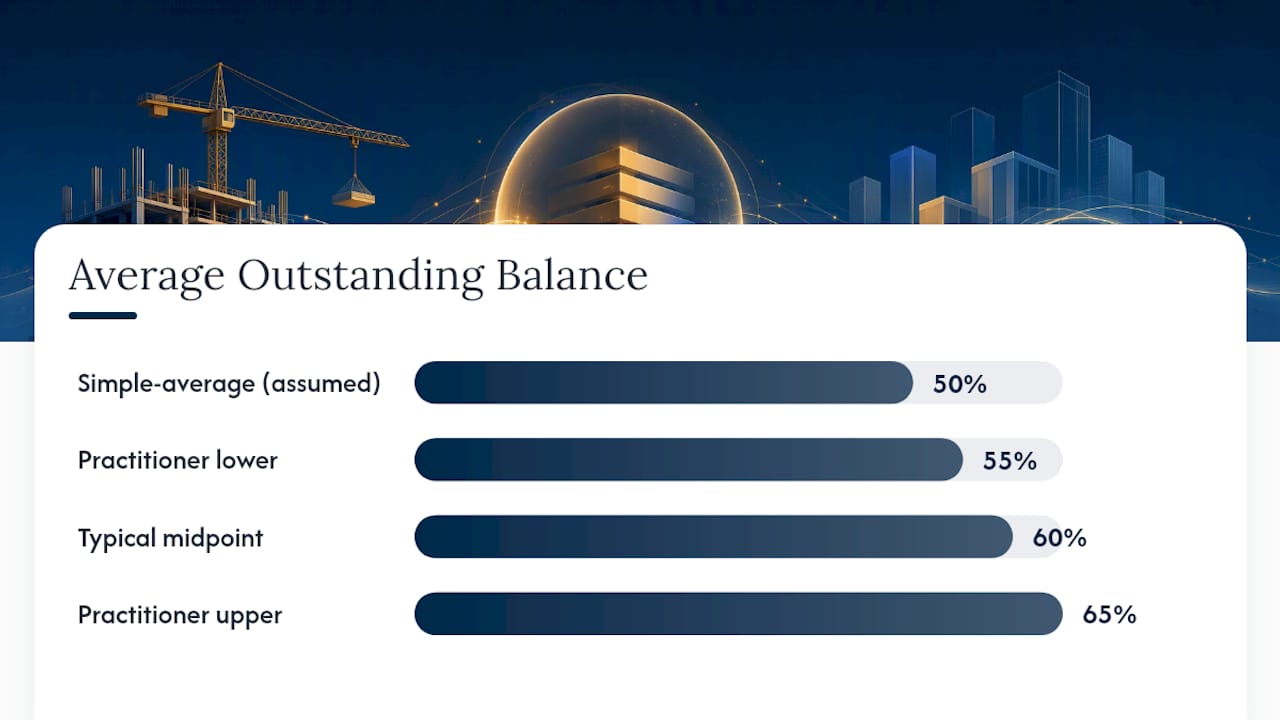
- Average outstanding balance across the full term typically lands well above a simple 50% assumption
Practitioner analysis of typical vertical-construction S-curves shows average outstanding balances running closer to 55 to 65 percent of the total loan, rather than the 50% a quick formula assumes.
There’s a second wrinkle: capitalized interest. When your lender deducts interest owed from the reserve itself, that deduction increases your outstanding balance, which in turn increases the interest owed next month. It’s a circular reference. You can’t solve it with a single formula pass. That’s exactly why draw-by-draw modeling exists.
How to Calculate Your Interest Reserve
Two methods handle this calculation, and you should know both even though only one belongs in your final underwriting.
The simple-average method: multiply your loan amount by an assumed average percentage outstanding, by your annual interest rate, by the fraction of the year the loan runs. Treat this as a five-minute gut check, never as your actual reserve figure, given what the S-curve data above shows about real average balances.
The draw-by-draw method is more work but far more defensible. You build a monthly schedule, calculate interest on the actual outstanding balance each month, and sum those monthly figures across the full term. Practitioner guidance frames the monthly accrual as the prior month’s balance plus half the current month’s draw, multiplied by the annual rate divided by 12, which approximates the effect of interest accruing gradually rather than all at once. Because reserve draws add to the balance that generates the next month’s interest, you resolve the circularity with an iterative calculation rather than a single formula.
Before you start, gather these inputs:
- Total loan commitment and expected monthly draw amounts
- Contract interest rate plus a worst-case rate if your loan floats.
- Full construction term, including a delay buffer
- A contingency percentage for cost overruns
Pro Tip: Build your draw schedule against your contractor’s actual construction timeline, not a generic template. A schedule that front-loads site work but back-loads a long finish phase changes your average outstanding balance more than most sponsors expect.
A Worked Example: $2 Million Loan Over 12 Months
The draw-by-draw method starts from an S-curve draw schedule and calculates interest on the actual monthly outstanding balance, resolving the capitalized-interest circularity through iteration. With an average outstanding balance closer to 60%, consistent with the practitioner-documented 55 to 65 percent range for typical S-curve draws, the reserve comes out closer to $108,000.
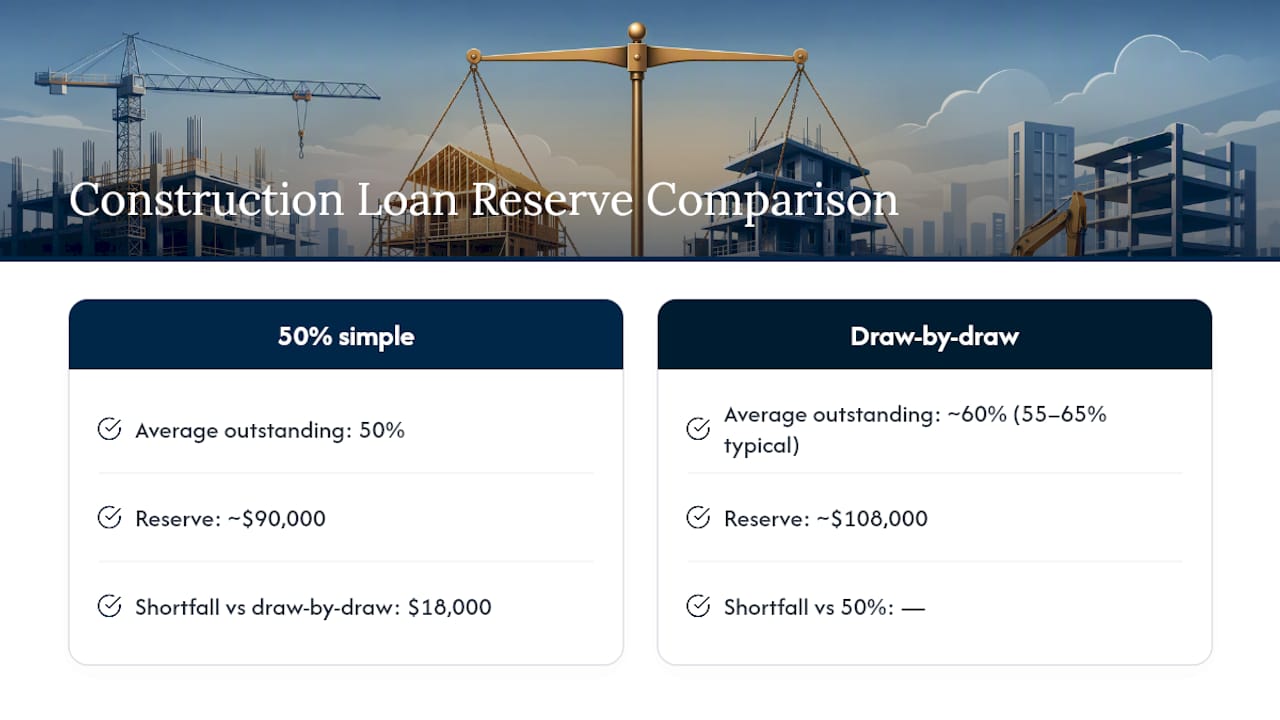
That $18,000 gap on a modest $2 million loan is money that has to come from somewhere if your simple-average number was the one written into your loan. On larger projects, the same percentage gap turns into real six-figure shortfalls, and it lands on your sponsor equity right when you have the least flexibility to cover it.
When Your Interest Reserve Runs Out
A depleted reserve doesn’t end your project, but it does put your lender in the driver’s seat. FDIC supervisory guidance on commercial real estate lending emphasizes conservative modeling precisely because reserve shortfalls are common enough that examiners watch for them.
When a reserve runs dry, lenders typically respond in one of a few ways:
- Withholding future draws until the shortfall gets addressed
- Issuing a formal cure notice with a deadline
- Offering a loan amendment or short-term forbearance, usually with added fees
On your end, you have real options rather than a forced default. You can inject additional equity to cover the gap, reallocate unused portions of your construction contingency, negotiate a modest loan increase with your lender, or arrange short-term bridge financing to carry the project through completion. Whatever path you choose, communicate with your lender before the shortfall happens, not after. Documented, proactive conversations preserve your draw schedule far more often than surprise calls asking for an emergency amendment.
Building a Defensible Interest Reserve Model
A reserve calculation only holds up under scrutiny if you can show your work. Before you finalize any number, confirm these pieces are in place:
- A complete sources-and-uses statement showing where every dollar of the loan and equity goes
- A month-by-month draw schedule tied to your contractor’s actual construction timeline
- Your contract interest rate and a documented worst-case rate if the loan floats
- A contingency line sized at 10 to 25% above your baseline reserve calculation
If you’re building this in Excel, turn on iterative calculation under Formula options, since the capitalized-interest circularity described earlier will otherwise throw a circular-reference error. Set a reasonable iteration limit, around 100 passes, and a convergence threshold near 0.001, so the model settles on a stable number instead of looping indefinitely.
Pro Tip: Document every assumption in a visible tab of your model, not buried in cell comments. Lenders reviewing your reserve calculation want to see your rate assumptions and draw timing at a glance, not hunt for them.
Construction delays and floating-rate exposure are the two most common reasons reserves run short, and practitioner guidance consistently recommends padding the calculated number rather than treating it as precise.
Getting Your Construction Loan Structured Right
Sizing a reserve accurately is only half the job. The other half is getting a lender who understands construction financing well enough to structure the loan around your actual draw schedule instead of a generic template. Surge-financial has facilitated more than $2 billion across 500-plus closed deals, including ground-up construction and real estate transactions where reserve sizing directly affects loan-to-cost ratios and sponsor equity requirements.
Capital advisors at Surge-financial typically move qualified transactions toward funding within 1 to 3 business days, and the consultative process includes a review of your draw schedule and interest assumptions before you commit to a lender’s borrowing rules number. If you’re preparing for that conversation, bring your sources-and-uses statement, draw schedule, contractor timeline, and current pro forma. Those four documents let an advisor spot an undersized reserve before it becomes a mid-construction crisis.
Why the 50% Rule Persists Even Though It’s Usually Wrong
The simple-average formula survives because it’s easy, not because it’s accurate.
What gets underweighted in most conversations about construction financing is the circularity problem. Sponsors build a reserve number, hand it to their lender, and never revisit it once draws start flowing at a different pace than assumed. A draw-by-draw model isn’t just more accurate on day one. It’s the only approach that lets you re-forecast when your actual draws diverge from plan, which they almost always do to some degree.
If there’s one thing to prioritize, it’s building the iterative model before you sign, not after your third draw request gets questioned. A spreadsheet with iterative calculation turned on and a documented contingency line costs you an afternoon. A depleted reserve six months into a build costs you leverage with your lender at the worst possible moment.
— Brandon
Get Your Construction Loan Structured Around the Right Numbers
Surge-financial is the alternative to guessing at a reserve number and hoping your lender’s template matches your actual draw schedule.

With over $2 billion facilitated across 500-plus closed deals and no upfront fees or hard credit pulls, Surge-financial’s advisors work through a consultative process that typically funds vetted transactions within 1 to 3 business days. Whether you need a full ground-up construction loan or a bridge loan to cover a reserve shortfall mid-build, bring your draw schedule and current pro forma to your first call. An advisor will walk through your numbers and tell you exactly what financing structure fits your project’s actual timeline.
Sources
- Comment for Appendix D - Multiple-Advance Construction Loans | Consumer Financial Protection Bureau
- Supervisory Insights (FDIC) — CRE lending guidance
- Construction loans draw schedules & interest reserves (APERS)
- How to calculate an interest reserve for a construction loan — PropertyMetrics
Recommended
Get Started with Surge Financial
Talk to a dedicated Surge Financial advisor. No hard credit pull, no upfront fees, and you see every option before deciding.
Get Started →