
Truly paperwork-free business loans barely exist. What lenders market as “no doc” almost always means limited documentation, not zero documentation. Instead of tax returns and full financial statements, lenders look at your business bank account, merchant processor history, or sales platform data to decide if you qualify. The realistic options are merchant cash advances, invoice financing, revenue-based financing, platform-based advances from payment processors, and low-doc lines of credit or term loans from online lenders.
Every one of these trades speed for cost. You can often get funded in a day or two, but you’ll usually pay more than you would with a bank loan or an SBA-backed loan.
Before applying anywhere, do this:
- Compare the total repayment cost, not just the headline rate.
- Check whether payments come out daily, weekly, or monthly.
- Ask whether a personal guarantee or lien is required.
- Talk with a capital advisor if you need speed but also want to avoid predatory terms.
Key Takeaways
No-doc business loans trade speed and light paperwork for higher cost and shorter repayment windows, making them a fit for urgent, short-term needs rather than long-term capital.
| Point | Details |
|---|---|
| “No doc” means limited doc | Lenders still verify revenue through bank statements or merchant data, not zero documentation. |
| Match product to need | Merchant cash advances, invoice financing, and revenue-based funding each suit different business models. |
| Cost hides in the cadence | Daily repayment schedules produce higher effective APRs than monthly ones at the same factor rate. |
| Verify before you sign | Check lenders on NMLS Consumer Access and the BBB before authorizing bank access. |
| Consider a guided path | Surge Financial matches borrowers to appropriate funding sources with reduced upfront paperwork and no early hard credit pull. |
Table of Contents
- What Is a No Doc Business Loan, Exactly?
- What Types of No Doc and Low Doc Financing Exist?
- Who Offers No Doc Loans and How Do They Underwrite Them?
- Is a No Doc Loan a Good Fit for Your Business?
- How Do You Qualify and Apply for a No Doc Loan?
- What Do No Doc Loans Actually Cost?
- When Should You Look at Alternatives Instead?
- How Surge Financial Helps You Get Funded Without the Paperwork Overload
- Why “Fast” and “Easy” Aren’t the Same Thing
- Get Fast Capital Without the Guesswork of Shopping Alone
- Frequently Asked Questions
- Sources
What Is a No Doc Business Loan, Exactly?
“No doc” and “low doc” get used almost interchangeably in lending marketing, and both describe the same reality: reduced paperwork, not the absence of it. Lenders still need proof your business generates revenue and can repay what it borrows. According to Investopedia’s explainer on no-doc business loans, these products replace tax returns and audited financials with alternative data, such as three to six months of bank statements or merchant processor records.
Compare that to a traditional bank loan or an SBA loan through the 7(a), 504, or microloan programs. Those require more paperwork: tax returns, profit and loss statements, sometimes a business plan and collateral schedule. In exchange, you typically get a lower interest rate and a longer repayment term. The SBA itself isn’t a no-doc lender and never claims to be. It’s the affordable alternative on the other end of the spectrum, and it’s worth understanding both ends before you pick a lane.
The terminology matters because “no doc” gets thrown around by marketers to mean “fast and easy,” when what’s actually happening is a shift in what gets verified, not whether anything does. Lenders offering these products have simply found a different way to answer the same underlying question: will this business pay us back?
What Types of No Doc and Low Doc Financing Exist?
Each product type fits a different business model and cash need. Here’s how the main categories break down:
- Merchant cash advances. A lender gives you a lump sum in exchange for a percentage of future card sales. Best suited to retail stores, restaurants, and other businesses with steady daily card volume. Repayment scales with sales, which helps in slow weeks but stretches out cost over time.
- Invoice financing and factoring. B2B companies with unpaid invoices can sell those invoices to a factor for immediate cash, minus a fee and a holdback (typically released once the customer pays). This works well for businesses with long payment cycles and creditworthy customers.
- Revenue-based financing and short-term working capital. Lenders assess monthly revenue trends and offer a lump sum repaid as a fixed percentage of ongoing revenue or through short, scheduled installments.
- Platform-based advances. Payment processors and ecommerce platforms increasingly offer advances based on your sales history within their own system. Speed here comes from the platform already holding your transaction data.
- Low-doc lines of credit and online term loans. Some online lenders offer lines or term loans that only feel “no doc” because the application process is digital and fast, even though they still check bank activity and credit.
Who Offers No Doc Loans and How Do They Underwrite Them?
Three types of providers dominate this space: alternative fintech lenders, merchant payment processors, and invoice factoring companies. A smaller group of specialty nonbank firms round out the market, often focusing on specific industries like trucking, construction, or healthcare.
Without full financial statements, these lenders lean on alternative signals to price risk:
- Bank account deposit trends over the past three to twelve months.
- Point-of-sale or sales-platform data showing revenue consistency.
- Merchant processor history, if you already process card payments through them.
- A soft credit pull, which doesn’t hurt your credit score the way a hard inquiry does.
In exchange for skipping the paperwork mountain, lenders protect themselves with tools like personal guarantees, UCC liens on business assets, or a slightly higher price on the loan itself. NerdWallet’s overview of alternative lending notes that faster approvals and funding, sometimes within 24 to 72 hours, come paired with higher rates and shorter terms than a bank would offer.
Pro Tip: Before signing anything, check the lender on NMLS Consumer Access and the Better Business Bureau. A legitimate no-doc lender will have a registration record and a traceable complaint history. If you can’t find either, treat that as a warning sign, not a coincidence.
Is a No Doc Loan a Good Fit for Your Business?
Speed is the entire selling point. If a supplier needs payment tomorrow or a piece of equipment breaks down mid-season, a no-doc product can get you funded before a bank even finishes reviewing your application. Startups and businesses without three years of tax returns also get a shot at capital they’d otherwise be locked out of.

The tradeoff shows up in the cost. NerdWallet’s comparison points out that alternative lenders charge more and give you less time to repay. Daily or weekly payment schedules can push the effective annual cost several times higher than the nominal rate suggests, and many products still require a personal guarantee even without full documentation.
Choose a no-doc option when:
- You need funds within days, not weeks.
- The need is short-term and self-limiting (inventory, payroll gap, emergency repair).
- You’ve already priced the total cost and can absorb it.
Avoid it when:
- You’re financing something long-term, like an expansion or major equipment purchase.
- You haven’t compared it against an SBA loan or bank line of credit.
- The lender won’t clearly disclose the total repayment amount.
How Do You Qualify and Apply for a No Doc Loan?
Even “minimal paperwork” financing has a checklist. Gather these before you start applying anywhere:
- Three to six months of business bank statements.
- Merchant processing statements, if applicable to your business.
- Your EIN, business formation documents, and a government-issued ID.
- Basic details on monthly revenue and time in business.
Credit requirements vary widely by product. Some lenders in this space accept scores in the 500 to 600 range because they weigh cash flow more heavily than credit history. Others still want a stronger score if you’re asking for a larger amount. Time in business matters too. Many fintech lenders will work with businesses that have only a few months of operating history, since they’re reading bank deposits rather than tax filings.
Once you’ve gathered documents, the process usually runs like this: compare at least two or three offers side by side, ask each lender for a full breakdown of fees, and confirm exactly how repayment will be deducted before you authorize access to your bank or merchant account. Funded offers typically arrive within one to three business days after approval.
Pro Tip: Ask every lender this exact question: “What is the total dollar amount I’ll repay, and over what period?” If they dodge it or only quote a factor rate, that’s your answer about how transparent they intend to be.
Watch for red flags like upfront fees before funding, vague repayment terms, or pressure to sign within hours. Legitimate lenders don’t need to rush you.
What Do No Doc Loans Actually Cost?
Lenders in this space rarely quote an APR up front. Instead, they use a factor rate, a simple multiplier like 1.2 or 1.4 applied to the amount you borrow. A $50,000 advance at a 1.3 factor rate means you repay $65,000 total, regardless of how long it takes.
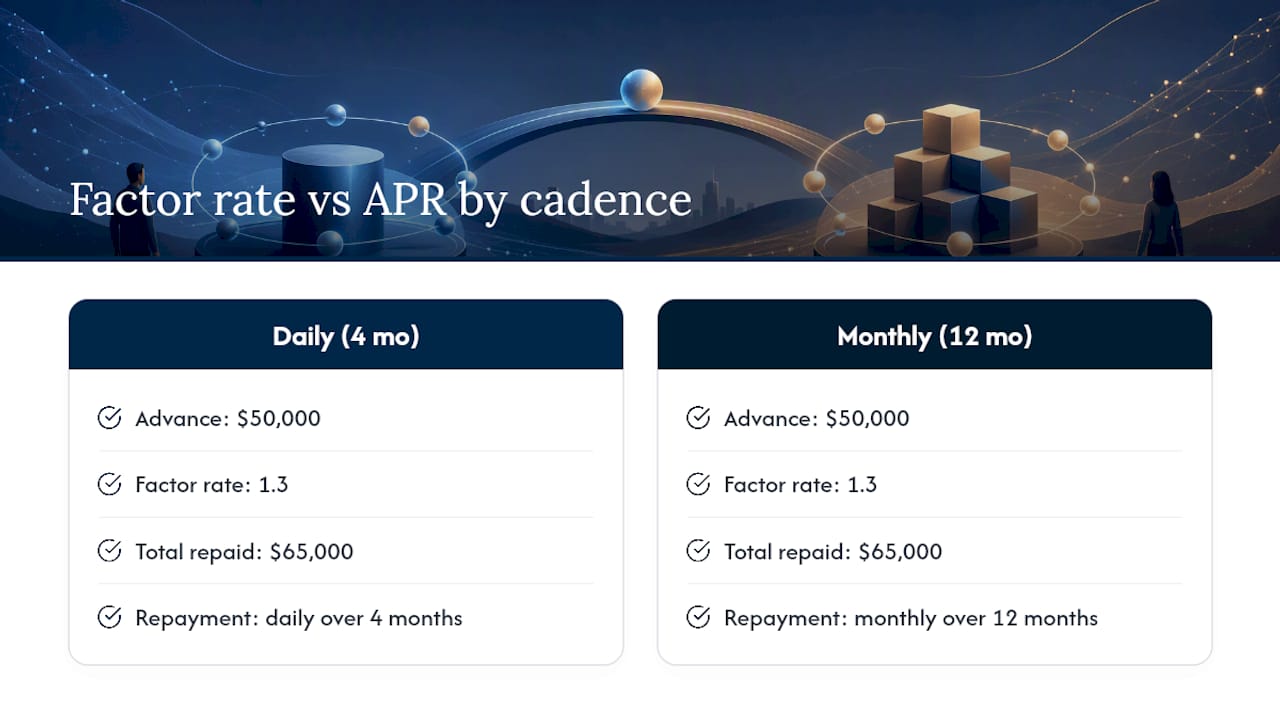
The problem is that factor rates hide the time value of money. Investopedia’s breakdown of no-doc loan pricing shows that converting a factor rate into an estimated APR reveals the real cost, and repayment cadence changes that number dramatically. The same $65,000 repayment on a $50,000 advance, paid daily over four months, produces a much higher effective APR than the same total repaid monthly over twelve months. Faster remittance schedules always cost more in annualized terms, even when the sticker factor rate looks identical.
Pricing bands shift based on your industry, how volatile your revenue is month to month, the size of the loan, and the term length. Before accepting an offer, ask the lender to state the total repayment amount and the schedule, then do the APR math yourself or ask an advisor to do it for you.
When Should You Look at Alternatives Instead?
If your timeline allows for a few extra weeks, alternatives usually cost less. SBA loans through the 7(a), 504, or microloan programs require more documentation but offer better rates and longer terms, making them the stronger choice for expansion, real estate purchases, or major equipment.
A traditional bank or credit union product, or a business line of credit, makes sense when you need a larger amount or want lower ongoing interest costs rather than a one-time advance. Community Development Financial Institutions (CDFIs) fill a real gap too, often serving borrowers that traditional banks turn away, with more flexible underwriting than a bank but better pricing than a merchant cash advance.
How Surge Financial Helps You Get Funded Without the Paperwork Overload
You don’t have to choose between “fast but expensive” and “affordable but slow.” Surge Financial has facilitated over $2 billion in capital across more than 500 successful deals by taking a different approach: consultative advisors review your situation first, then match you to the funding source that actually fits.
That process cuts unnecessary paperwork without cutting corners on compliance, and it happens without a hard credit pull early on. Here’s what that looks like in practice:
- A dedicated capital advisor assesses your business before recommending a product.
- You get matched to lenders and structures suited to your actual need, not a one-size-fits-all offer.
- Most clients see funding within one to three business days once matched.
Why “Fast” and “Easy” Aren’t the Same Thing
The conventional advice on no-doc loans treats speed as the whole story, and that’s where most of it falls short. Speed is real, but it’s a symptom of a different underwriting model, not a favor the lender is doing you. Every hour saved on paperwork gets priced somewhere else, usually in the factor rate or the repayment schedule.
What gets underrated is how much the repayment cadence changes the real cost. Two offers with the same factor rate can differ enormously in effective APR depending on whether you’re paying daily or monthly, and most borrowers never do that math before signing. That single number, converted honestly, tells you more than any marketing page about “same-day funding.”
My take: treat no-doc financing as a tool for a specific, short-term problem, not a default financing strategy. If you’re weighing it because you genuinely need cash in 48 hours, fine. If you’re weighing it because applying for an SBA loan sounds tedious, slow down and get a second opinion before you commit to a year of daily withdrawals.
Get Fast Capital Without the Guesswork of Shopping Alone
Comparing merchant cash advances, invoice factors, and online lenders on your own means reading a dozen fee structures and hoping you did the APR math right. Surge Financial gives you a capital advisor instead, someone who reviews your bank statements, revenue trends, and timeline, then presents financing options that actually fit, from short-term working capital to SBA loans and equipment financing.
That consultative process is what separates Surge-financial from shopping blind through no-doc lender ads. There’s no upfront fee, no hard credit pull to start the conversation, and most clients see funding decisions within one to three business days once matched to the right source. Whether you’re a retail operator needing working capital or a contractor eyeing equipment financing, the starting point is the same: talk to an advisor before you sign anything with a factor rate attached. Visit Surge Financial’s business funding page to get matched with the right option for your situation.
Frequently Asked Questions
Is there such a thing as a truly no-documentation business loan? Not in practice. Every legitimate lender verifies some form of revenue or bank activity, even if it skips tax returns and formal financial statements.
How fast can I get funded with a no-doc business loan? Many alternative lenders fund within 24 to 72 hours once approved, according to NerdWallet’s lending overview. Surge Financial’s advisory process typically results in funding within one to three business days.
What credit score do I need for a no-doc business loan? Requirements vary by product, but some lenders accept scores in the 500 to 600 range since they weigh cash flow more heavily than credit history.
Are no-doc business loans more expensive than SBA loans? Almost always. SBA loans require more documentation but offer better rates and longer terms, making them cheaper over time for borrowers who can wait through the approval process.
What should I watch for to avoid a predatory no-doc lender? Avoid any lender that demands upfront fees before funding, won’t disclose the total repayment amount, or pressures you to sign within hours. Check registration through NMLS Consumer Access first.
Sources
Get Started with Surge Financial
Talk to a dedicated Surge Financial advisor. No hard credit pull, no upfront fees, and you see every option before deciding.
Get Started →