
The SBA 504 program finances owner-occupied real estate and long-lived equipment through fixed-rate, long-term loans. You likely qualify if you run an operating, for-profit U.S. business that meets SBA size standards, can show credit isn’t available on comparable terms elsewhere, and can bring 10% equity to the project. Most deals split financing 50% bank, 40% CDC/SBA debenture, 10% borrower equity. Start by contacting a Certified Development Company to confirm your project fits.
TL;DR:
- Most SBA 504 loans require an applicant business to demonstrate unavailable conventional financing and provide at least 10% equity, which rises for startups or special-purpose projects.
- The typical project financing split is 50% bank, 40% SBA debenture, and 10% borrower equity, with equity increases for startup or specialized properties.
- Qualified uses include purchasing or renovating owner-occupied real estate and buying long-lasting equipment, while working capital and rental properties are ineligible.
- The application process involves detailed documentation and can take several weeks to months, with CDC certification influencing processing speed and project suitability.
- Proper preparation, including early review of ownership and financial documentation, reduces denial risks linked to repayment capacity and incomplete paperwork.
Table of Contents
- What the SBA 504 program is and when it’s right for your project
- Borrower eligibility: key business-level tests and documentation lenders check
- Project requirements: eligible uses, ineligible uses, and job-creation obligations
- Loan structure and down payment: the 50/40/10 split and exceptions
- Applying: CDC role, required forms, SOP checkpoints, and timeline
- Repayment, terms, and borrower obligations after closing
- How to prepare: a practical pre-application checklist
- What makes a Certified Development Company eligible to process your 504 loan
- What SBA 504 loans actually cost: CDC fees, guarantee fees, and closing costs
- Why SBA 504 loan applications get denied
- Surge Financial perspective: how an advisor helps meet 504 requirements
- Get help preparing your SBA 504 application
- Where to verify SBA 504 rules directly
- Sources
What the SBA 504 program is and when it’s right for your project
The 504 loan program exists to promote business growth and job creation by financing fixed assets at long-term, fixed rates. It works through a three-party structure: a conventional lender covers roughly 50% of the project, a Certified Development Company (CDC) provides an SBA-backed debenture covering about 40%, and you contribute the remaining equity.
That structure makes 504 a strong fit when you’re buying or renovating an owner-occupied building, or purchasing machinery expected to last a decade or more. It’s a poor fit when you need cash to cover payroll, restock inventory, or finance a speculative rental property you won’t occupy. The program is built around fixed assets tied to your operating business, not general liquidity.
Borrower eligibility: key business-level tests and documentation lenders check
CDCs and lenders run several checks before a 504 application moves forward. Understanding each one before you apply saves weeks of back and forth.
- Operating status: Your business must be for-profit, operating (not a startup shell with no activity), and physically located in the United States.
- Size standards: The SBA applies NAICS-based size tests covering revenue or employee count, depending on your industry.
- Character and capacity: Lenders verify management experience and your demonstrated ability to repay from projected cash flow, not just collateral value.
- Credit not available elsewhere: You need to show conventional financing on reasonable terms isn’t accessible, a rationale lenders formally certify during underwriting.
- Ownership disclosure: Anyone owning 20% or more, and all owners combined holding 51% or more, must be listed on SBA Form 1919.
Pro Tip: Gather three years of business and personal tax returns before your first CDC conversation. Incomplete ownership disclosure is one of the most common reasons applications stall at underwriting.
Tangible net worth and average net income limits also apply for some applicants, particularly larger operating companies near SBA’s alternative size standard. A CDC can tell you within one conversation whether your numbers clear that bar.
Project requirements: eligible uses, ineligible uses, and job-creation obligations
The 504 program funds fixed assets tied directly to your operations, not working capital or speculative investment.
Eligible uses:
- Purchasing, constructing, or renovating owner-occupied commercial buildings
- Buying machinery and equipment with a useful life of 10 years or more
- Certain project-related fees and interim financing costs
Ineligible uses: working capital, inventory, and speculative rental real estate you won’t primarily occupy. Federal regulation 13 CFR §120.882 also restricts using 504 proceeds to refinance debt that doesn’t meet the program’s qualified-debt definition.
Job creation matters too. Standard projects must support roughly one job per $75,000 of debenture funding, though small manufacturers face different thresholds. Special-purpose properties, like a car wash or hotel, carry higher equity requirements because they’re harder to convert to another use if you default.
Loan structure and down payment: the 50/40/10 split and exceptions
The standard 504 project splits financing three ways: a senior lender funds about 50%, the CDC/SBA debenture covers roughly 40%, and you supply the remaining 10% as equity.
That 10% figure rises in two common scenarios, according to industry lending guides:
- Startups or special-purpose properties (gas stations, hotels, self-storage facilities): equity requirement increases to 15%.
- Startups combined with special-purpose properties: equity requirement rises to 20%.
Say you’re buying a $2 million owner-occupied warehouse as an established business. Your senior lender funds $1,000,000, the CDC debenture covers $800,000, and you bring $200,000 in equity. If that same warehouse were a newly formed business, your required equity jumps to $300,000.
Acceptable equity sources include verified cash, existing real property equity, and in some cases seller standby notes, though those notes carry strict subordination rules and must be injected at or before closing, not promised for later. Run your own numbers through a commercial real estate loan calculator before you meet a CDC, so you walk in knowing your equity gap.
Applying: CDC role, required forms, SOP checkpoints, and timeline
Contact a CDC first. CDCs originate 504 loans, coordinate with your senior lender, and interpret SBA rules in practice, often deciding exactly which documents your file needs.
Expect to submit:
- SBA Form 1244, the formal 504 loan application listing project costs
- SBA Form 1919, disclosing beneficial ownership
- Personal financial statements and three years of business and personal tax returns
- Project pro formas, construction budgets, and environmental or flood zone determinations
The SOP 50 10 series sets the operational rules CDCs follow, covering applicant certification, borrower contribution documentation, and refinancing clarifications. These updates shift periodically, so a CDC’s current guidance matters more than an old checklist you found online.
Timing runs in phases: interim financing bridges the gap while your CDC prepares the debenture for sale, then the debenture sells and disburses, typically closing out the process. From a complete application to funding, expect the process to take several weeks to a few months, depending on construction timelines and environmental review.
Repayment, terms, and borrower obligations after closing
Maturities depend on what you’re financing. Equipment loans typically run 10 years, real estate loans run 20 to 25 years, and some projects blend both into a single structure matching each asset’s useful life.
The CDC/SBA debenture carries a fixed rate for its entire term, which is one of the program’s biggest advantages over conventional commercial financing. Your senior lender portion, by contrast, may carry a variable or fixed rate depending on that lender’s own terms, so your blended payment isn’t uniformly fixed.
After closing, you’ll maintain hazard insurance on financed assets, and flood insurance is required whenever collateral sits in a FEMA-designated special flood hazard area. If construction runs behind schedule, your debenture sale and disbursement can be delayed, which is why interim financing exists to keep contractors paid in the meantime.
How to prepare: a practical pre-application checklist
Walking into your first CDC meeting prepared changes how fast your file moves.
- Assemble three years of business and personal tax returns, current financial statements, and a debt schedule.
- Pull together lease agreements, construction plans, or equipment specifications tied to your project.
- Document your equity source, bank statements, a subordination agreement for standby notes, or proof of real property equity.
- Ask your CDC directly how they define credit-not-available-elsewhere for your industry and what equity documentation they’ll accept.
- Confirm your expected timeline before you sign any purchase contract or construction agreement.
Pro Tip: Ask your CDC for their common denial reasons before you submit. Most will tell you exactly what tripped up their last three declined files, which is the fastest way to fix a weak spot in yours.
What makes a Certified Development Company eligible to process your 504 loan
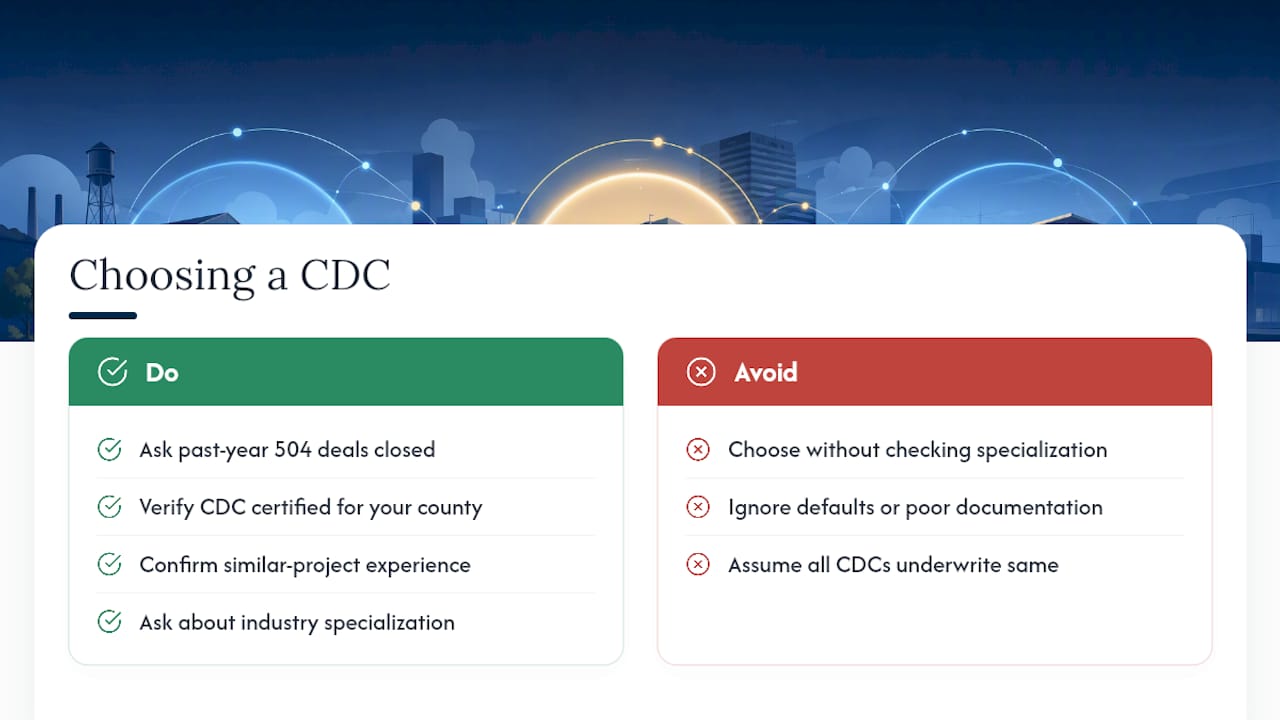
CDCs aren’t generic lenders. They’re nonprofit corporations certified and regulated by the SBA specifically to package and service 504 loans within a defined geographic area, usually a state or multi-county region.
To hold that certification, a CDC must maintain a professional staff experienced in commercial lending and loan servicing, operate under a board of directors that includes representation from the local business community, and demonstrate ongoing compliance with SBA reporting and portfolio performance standards. The SBA reviews CDC performance periodically, and a CDC with a weak track record on defaults or documentation can lose its certification.
For you as a borrower, this matters practically. A CDC’s certification determines whether it can lend in your county, and its internal underwriting culture shapes how strictly it interprets gray areas like credit-not-available-elsewhere or acceptable equity documentation. Some CDCs specialize in specific industries or property types, like healthcare facilities or manufacturing, and that specialization often translates into faster, more informed underwriting for a project in their wheelhouse.
Before committing to one CDC, ask how many 504 deals they closed in the past year and whether they’ve handled a project similar to yours. A CDC that regularly finances medical office buildings will move faster on your clinic purchase than one whose portfolio is mostly retail strip centers.
What SBA 504 loans actually cost: CDC fees, guarantee fees, and closing costs
Fees on a 504 loan attach mostly to the CDC/SBA debenture portion, not the senior lender piece, and most of them get financed into the debenture rather than paid out of pocket at closing.
The CDC processing fee typically runs around 1.5% of the debenture amount, covering the CDC’s work packaging and servicing your loan.
Beyond those program-specific fees, expect standard closing costs: title insurance, appraisal fees, environmental Phase I reports, and legal fees for document preparation. Your senior lender charges its own origination fee separately, following whatever pricing that bank or credit union sets for commercial real estate or equipment loans.
Ask your CDC for an itemized fee sheet early. Fee percentages shift periodically with SBA policy updates, and getting a current number beats relying on a figure you saw in an older guide.
Why SBA 504 loan applications get denied
Most 504 denials trace back to a handful of recurring issues, and nearly all of them are preventable if you catch them before submission.
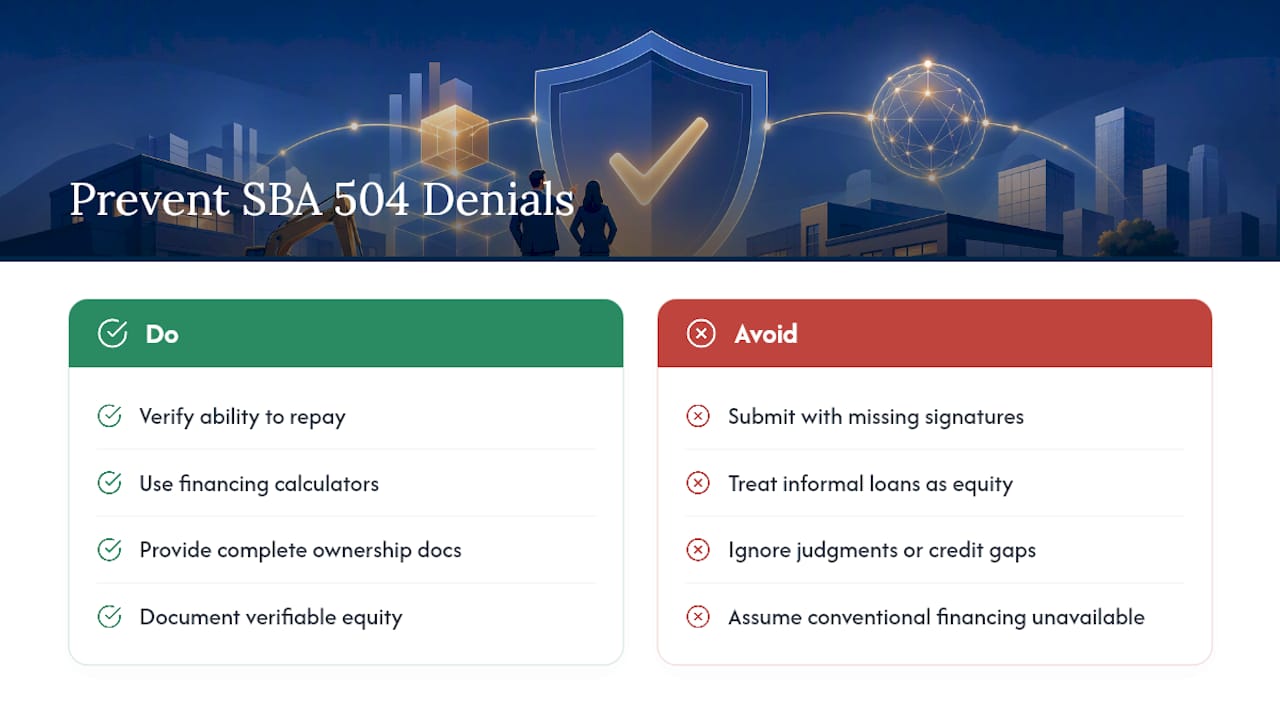
Weak or unclear ability to repay tops the list, so use financing calculators to verify your debt-service capacity before applying. If your projected cash flow doesn’t comfortably cover the new debt service alongside existing obligations, underwriters will flag it, even when collateral value looks strong. A second common issue is incomplete or inconsistent ownership documentation. Missing signatures on Form 1919, or ownership percentages that don’t match what’s on your tax returns, stall files fast.
Insufficient equity is another frequent culprit. Borrowers sometimes assume they can substitute unverified promises or informal family loans for real equity, but CDCs require documented, verifiable sources, and standby notes must meet strict subordination terms. Character issues, including unresolved judgments, unexplained credit history gaps, or past SBA loan defaults, can also sink an otherwise strong application.
Finally, projects that don’t clearly meet the credit-not-available-elsewhere standard get pushback, especially when a borrower could reasonably obtain conventional financing without SBA support. If your CDC flags this early, it’s often fixable by adjusting your loan-to-value ratio or providing additional documentation showing why conventional terms weren’t available.
The fix for nearly every one of these issues is the same: address it before submission, not after a denial letter. A pre-application review with your CDC or a capital advisor catches most of these problems while there’s still time to correct them.
Surge Financial perspective: how an advisor helps meet 504 requirements
Most 504 denials trace back to preparation gaps, not eligibility gaps. Businesses that fail usually had a fundable project but showed up with incomplete equity documentation or an unclear credit-not-available-elsewhere case.
An advisor’s real value is coordination: sourcing acceptable equity paperwork, sequencing interim financing so construction doesn’t stall, and keeping your CDC and senior lender working from the same file. That matters most for startups, special-purpose properties, and refinancing scenarios where qualified-debt rules get complicated fast.
— Brandon
Get help preparing your SBA 504 application
Surge-financial works as your capital advisor, not another lender adding friction to the process. There’s no upfront fee, no hard credit pulls to get started, and our advisors coordinate directly with CDCs and senior lenders so you’re not chasing paperwork across three institutions alone.
Whether your project is a warehouse purchase, an equipment upgrade, or a construction buildout, our team has helped structure over $2 billion in financing across 500+ closed deals, including SBA loans, equipment financing, and real estate financing. Most clients get a funding pathway mapped out within one to three business days of their first conversation. Reach out to a Surge-financial advisor to review your project details and find out exactly what equity and documentation your file needs before you approach a CDC.
Where to verify SBA 504 rules directly
Confirm current rules at the SBA 504 program page, the 504 factsheet, 13 CFR §120.882, and SBA Form 1244 for the official application.
Sources
Get Started with Surge Financial
Talk to a dedicated Surge Financial advisor. No hard credit pull, no upfront fees, and you see every option before deciding.
Get Started →